


The Ultimate Guide to Compressed Air Flow Meter Selection
2026-06-02
Compressed air is the second largest power source in modern manufacturing, right after electricity. However, it is also one of the most expensive utilities, with system leaks and inefficiencies costing factories thousands of dollars annually.
When conducting a compressed air flow meter selection, selecting the right instrument is critical to achieving accurate energy monitoring, leak detection, and ISO 50001 compliance. This comprehensive guide outlines the core selection parameters, typical application scenarios, troubleshooting tips, and leading global brands.
1. 5 Core Dimensions for Compressed Air Flow Meter Selection
To ensure long-term stability and precision, engineering and procurement teams should evaluate any compressed air flow meter across the following five technical dimensions:
1.1 Process & Operating Conditions
-
Operating Pressure: Typically ranges from 0.4 to 1.6 MPa. For high-pressure applications (2.5 MPa or higher), a high-pressure rated body or flange must be specified.
-
Process Temperature: Standard range is -20°C to 80°C. High-temperature environments (above 120°C) require specialized high-temperature sensors or remote/split displays.
-
Air Cleanliness (ISO 8573-1 Classes): If the compressed air contains oil, moisture, or particulate matter, anti-fouling instruments are mandatory (e.g., vortex meters with drainage or coated thermal mass probes). Otherwise, pre-filters or dryers must be installed.
-
Flow Fluctuations: For systems with heavy flow fluctuations or those dedicated to low-flow leak detection, a wide turndown ratio (50:1 or higher, ideally 100:1 or higher) is essential.
1.2 Accuracy Grade Requirements (Based on Application)
-
Custody Transfer / Cost Allocation: +/- 1.0% FS to +/- 0.5% RD (Thermal Mass / Gas Turbine / Coriolis)
-
Energy Monitoring / Workshop Audits: +/- 1.0% to +/- 1.5% FS (Vortex / Differential Pressure)
-
Process Control: +/- 1.5% to +/- 3.0% FS
-
Basic Indication Only: Above +/- 4.0% FS (Variable Area / Metal Tube Rotameter)
1.3 Piping & Installation Constraints
-
Pipe Size (DN): Inline or flanged types are preferred for DN15 to DN300. Insertion types are highly recommended for DN sizes of 200mm and above due to significantly lower hardware costs and zero pressure drop.
-
Straight Pipe Runs: Vortex flow meters typically require 10D upstream and 5D downstream. Thermal mass and ultrasonic variants generally require shorter straight runs depending on the piping geometry.
-
Space & Vibration: In confined spaces or areas near reciprocating air compressors with high vibration, opt for no-moving-parts, vibration-resistant designs (e.g., thermal mass meters).
-
Hot-Tapping (No Shutdown Retrofits): For existing pipelines that cannot be shut down, an insertion thermal mass flow meter is the ideal choice as it supports hot-tapping (ball-valve installation under pressure).
2. Typical Application Scenarios in Air Compressor Stations
| Application Scenario | Description | Recommended Flow Meter Type |
| Main Header Metering | Measures total air production at the compressor room outlet to calculate overall system efficiency and specific power. | Thermal Mass Flow Meter, Vortex Flow Meter |
| Workshop/Branch Auditing | Tracks air consumption across different production lines or workshops for internal cost accounting. | Thermal Mass Flow Meter |
| Leak Detection | Identifies baseline air leaks during non-production hours. Compressed air leaks average 30% of total plant air. | Thermal Mass Flow Meter (Extreme low-flow sensitivity) |
| Pneumatic Equipment Consumption | Monitors air usage for pneumatic tools, sandblasting, and automated control systems in automotive, machining, and electronics lines. | Vortex Flow Meter |
| Energy Management & Energy Audits | Continuous tracking for ISO 50001 compliance and energy conservation optimization. | Thermal Mass Flow Meter, Vortex Flow Meter |
| Air Compressor Output Monitoring | Real-time monitoring of individual compressors for automated load balancing and intelligent sequencing (VSD/Fixed speed control). | Thermal Mass Flow Meter |
| Dryer/Filter Performance Evaluation | Compares flow data before and after dryers/filters to evaluate desiccant health, pressure drops, or air loss. | Thermal Mass Flow Meter |
| Cleanrooms (Pharma/Food & Beverage) | Ensures highly stable, precise, and sterile gas supply layouts. | Inline Ultrasonic Flow Meter, Sanitary Vortex Flow Meter |
3. Troubleshooting & Field Solutions
3.1 8 Common Field Failures in Compressed Air Measurement
-
"No response at low flow rates" – The meter sizing/bore was selected too large; the actual low flow velocity is buried below the meter's cut-off limit or noise floor.
-
"Unstable readings at high flow rates" – Insufficient straight pipe runs up/downstream, or severe pipe vibration causes mechanical or electronic signal distortion.
-
"Ghost readings on an empty pipe" – Mechanical plant vibration or heavy electromagnetic interference (EMI) is leaking into the signal cable.
-
"Flow readings drop every afternoon" – Drop in grid pressure combined with rising afternoon ambient temperatures causes standard volumetric readings to "shrink" if proper Temperature/Pressure (T&P) compensation is missing.
-
"Accurate in winter, inaccurate in summer" – The compressed air contains heavy moisture. Lower winter temperatures freeze/condense water early in the lines, while summer moisture coats the sensor probe with oil-water sludge.
-
"Intermittent signal or data dropouts" – Terminal oxidation, damaged cable shielding, or poor ground loops causing structural signal cuts.
-
"The meter drifts/reads slow after 6 months" – Oil and particulate matter have fouled the turbine bearings or baked onto the thermal mass sensor probes, requiring cleaning or factory recalibration.
-
"New meter throws errors immediately" – Incorrect field parameter configuration (e.g., wrong K-factor, actual pipe ID, or gas composition matrix).
3.2 Troubleshooting Matrix
To help field engineers resolve issues quickly, utilize this quick-action matrix:
| Symptoms | Potential Root Cause | Recommended Solution |
| Inaccurate Readings | Heavy pipe vibration (Vortex); Moisture/oil film condensation on probes (Thermal Mass). | Install dampening brackets or pipe hangers; Add upstream water separators or coalescing filters. |
| Signal Fluctuations / Noise | VFD (Variable Frequency Drive) air compressors causing high EMI noise. | Upgrade to twisted-pair shielded cables; Ensure the flow meter body is independently and reliably grounded. |
| Zero/Data Drift | Sensor contamination (oil sludge, carbon build-up, or fine dust particles). | Perform periodic sensor cleaning. Switch to an anti-fouling or self-cleaning sensor design. |
| Long-Term Systematic Error | Oversized meter body selection; Volumetric type missing active T&P compensation. | Recalculate sizing/turn-down requirements; Ensure Temperature & Pressure compensation modules are active and configured for Nm3/h or SCFM. |
| No Display / Zero Output | Power supply failure; Wiring polarity reversed; Faulty LCD or mainboard. | Check loop voltage (24V DC or 220V AC); Verify wiring diagram; Replace damaged electronic modules. |
| Erratic Signal Spikes | Severe flow disturbances from upstream valves or elbows; Shifted insertion depth. | Relocate meter to satisfy straight-run requirements; Verify and correct insertion depth and orientation alignment. |
4. Global Brand Overview: Market Landscape
When sourcing compressed air flow meters, the market is divided into high-end international pioneers and cost-effective, high-performance alternatives.
Cost-Effective & High-Performance Manufacturers
-
Aister Instrument: Focuses on Thermal Mass Gas Flow Meters for over 21 years. Ranked among the top 3 brands in the compressed air and fuel gas markets, offering free professional sizing reports and robust field-proven engineering.
-
CHUANYI: Known for solid cast-body vibration-resistant designs with integrated T&P compensation. Highly experienced in heavy-duty metallurgical, power, and chemical utility tracking.
-
DFJD: Features dual-sensor anti-vibration technology aimed at extreme vibration field settings with tight straight-run footprints.
-
SHANGHAI KENT: Positioned at roughly 1/3 the cost of tier-1 imports, specializing in easy protocol integration for smart air compressor stations and IoT energy platforms.
International Tier-1 Brands
-
Emerson (USA): The global technological benchmark for industrial instrumentation, featuring advanced multivariable processing and built-in smart diagnostic suites.
-
E+H (Switzerland): Premium instrumentation utilizing Heartbeat Technology for inline self-verification, delivering high stability and precision (+/- 0.1% FS available) under grueling process setups.
-
CS Instruments (Germany): Dedicated specifically to compressed air and technical gas measurement tools for over 20 years; their flagship VA 500 series supports hot-tapped installations on lines from 1/2 inch to 12 inches.
-
KROHNE (Germany): A global pioneer in custody transfer and industrial process measurement, offering ultra-wide turndown ratios and robust electromagnetic noise immunity across technical gases.
5. Aister Thermal Mass Flow Meters: Core Advantages
Brand Profile: Aister Instrument is an advanced high-tech manufacturer integrating R&D, precision CNC machining, and calibration services. With over 20 years of experience, the company operates three state-of-the-art DN15 to DN300 Sonic Nozzle Gas Flow Calibration Standards. Aister ships over 10,000 thermal mass flow meters annually across 163 countries and regions worldwide.
Product Series Breakdown
-
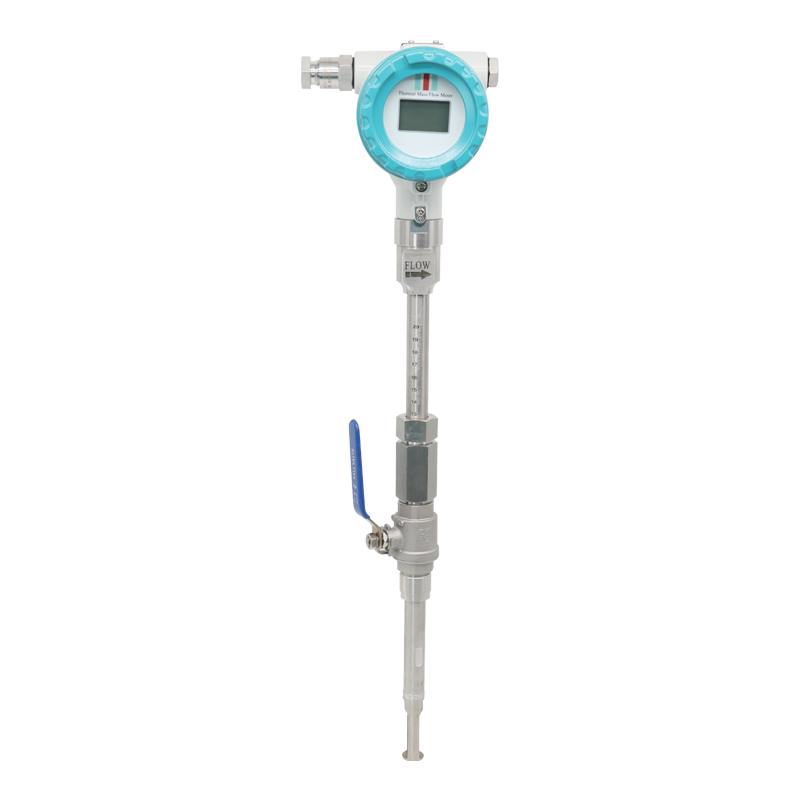
ATMF Insertion Type: Optimized for larger pipelines (DN32 up to DN2000). Supports hot-tapping for inline installation and maintenance without halting factory operations.
-
ATMF Inline Type: Optimized for small-to-medium pipes (DN15 to DN200). Calibrated alongside matching pipe runs at the factory for immediate plug-and-play precision.
.png)
-
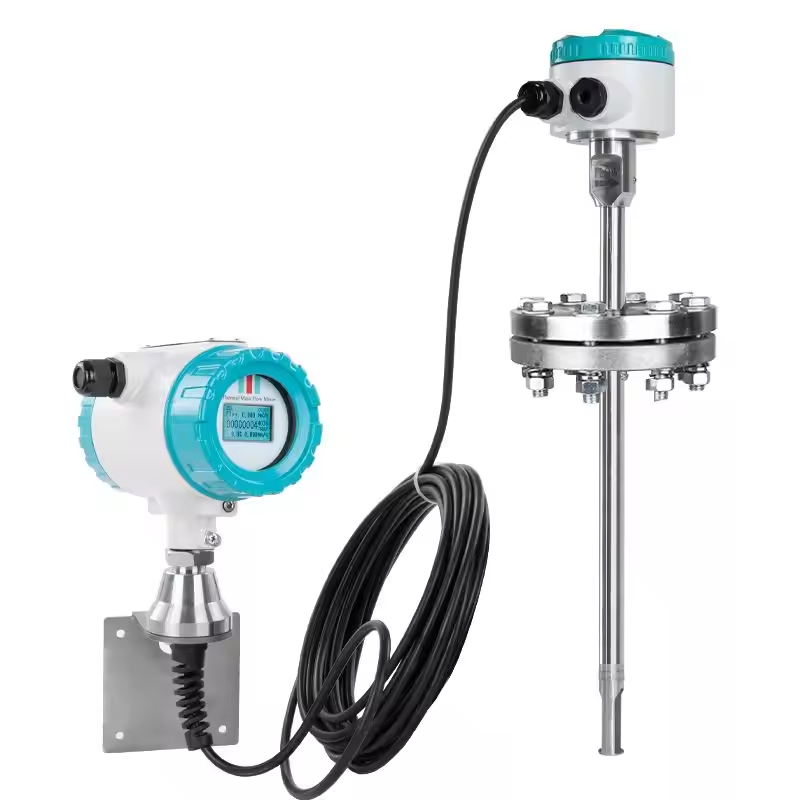
ATMF Remote/Split Type: The sensor probe and transmitter display are separated via industrial cabling. Rated up to 220°C, making it highly stable in severe vibrations or high-temperature ambient conditions.
Core Technical Advantages
-
Direct Mass Flow Measurement: Based on the Constant Temperature Differential (CTA) thermal diffusion principle. It directly measures mass flow or standardized volumetric flow (Nm3/h, SCFM) without requiring additional temperature and pressure sensors, eliminating multi-device error stacking.
-
Ultra-Wide Turndown Ratio (Greater than 100:1): Capable of capturing flow velocities from 0.1 Nm/s up to 120 Nm/s. A single instrument can handle low-velocity weekend leak detection and high-velocity peak production monitoring simultaneously.
-
High Precision & Repeatability: Designed with dual-reference platinum RTD bridge loop circuitry, achieving accuracies of +/- 0.5% to +/- 1.0% FS, with a repeatability of 0.2% or lower.
-
Rapid Response Time: Signal response time is 1 second or less (with high-speed variants hitting 0.5 seconds or less), ideal for dynamic process steps and pulsed pneumatic operations.
-
Zero Moving Parts, Negligible Pressure Drop: Because there are no spinning turbines or restricting orifices, it creates zero resistance in the air line. This lowers air compressor backpressure, saving significant electrical energy over time.
-
Rich Smart Communication Outputs: Supports standard 4-20mA, RS485 (Modbus RTU), HART, and Pulse outputs, paired with 1 or 2 relay alarm outputs for seamless integration into factory DCS/SCADA systems.
-
Unmatched Cost Performance: Delivers international tier-1 performance specifications at 1/3 to 1/4 the capital expenditure, providing the lowest total cost of ownership (TCO) across the equipment life cycle.
Industrial Application Note: Aister® Thermal Mass Flow Meters are highly recommended for factory main lines, branch energy management, leak mapping, and dryer audit systems. Field data confirms that optimizing compressed air loops via Aister tracking reduces total air compressor energy footprints by 10% to 25%. Note: For optimal performance, ensure the gas line remains relatively dry (Pressure Dew Point below -20°C) and schedule standard calibration validation every 1 to 2 years.
6. Compressed Air Flow Meter Selection Quick Reference Matrix
Use this application-first matrix to instantly narrow down your choices based on your primary system goals:
| Target Application | First Choice Option | Alternative Option | Key Selection Metrics |
| Main Header & Energy Management | Aister® Thermal Mass Flow Meter | Vortex Meter + T&P Compensation Modules | Wide turndown ratio, high accuracy, direct mass reading without compensation extras. |
| Leak Detection & Precise Branch Auditing | Thermal Mass Flow Meter | High-Sensitivity Low-Differential Pressure Meter | Extreme low-flow sensitivity (can measure down to velocities of 0.5 m/s and above). |
| High-Flow, Stable Main Header | Vortex Flow Meter | Precessional Vortex Flow Meter | High cost-efficiency; requires strict adherence to upstream straight pipe runs. |
| Large-Diameter Pipes (DN 300mm and above) | Insertion Thermal Mass Flow Meter | Insertion Ultrasonic Flow Meter | Low structural cost; supports hot-tapping without shutting down the air network. |
| High Vibration Environments (Compressor Discharge) | Precessional Vortex Flow Meter | Remote/Split Thermal Mass Flow Meter | Mechanical structural damping and digital signal filtering are mandatory. |
| Custody Transfer & Utmost Precision | Inline Thermal Mass Flow Meter | Coriolis Mass Flow Meter | Precision target of +/- 0.5% to +/- 1.0% RD; stable repeatability matrix. |
| Tight Budgets / Simple Indicator Setup | Variable Area Meter (Metal Tube Rotameter) | Small-Bore Vortex Flow Meter | Low acquisition cost; acceptable accuracy tolerances (above +/- 4.0%). |
Next Steps for Engineers
For standard air compressor installations, we recommend mounting a high-precision inline meter (such as the Aister® ATMF Series) at the main compressor station exit header, while utilizing economical variants or insertion types on branch lines. For ISO 50001 compliance, factory audits, or internal billing, ensure your instruments receive an annual calibration check.
Need Expert Assistance with Your Compressed Air System?
Don't risk choosing the wrong meter size or facing sensor drift issues down the line. Let our senior application engineers do the heavy lifting for you.
Get Your Free Custom Sizing & Selection Report Within 24 Hours:
-
Custom Sizing Calculation tailored to your actual pipe ID, velocity range, and grid pressure.
-
ISO 8573-1 Compliance Checklist to safeguard your sensors against oil and moisture.
-
ROI Evaluation demonstrating your projected energy and leak detection savings.
Share To:
Previous Post:
Next Post:
News
- Why is the thermal gas mass flowmeter not affected by pressure strength and temperature?
- What to do when a thermal gas mass flow meter fails?
- How are thermal gas mass flow meters used? What are the applications?
- Under what circumstances is the gas measurement need to be regulated compensated vortex flowmeter
- Why Is The Aister Thermal Gas Mass Flowmeter So Popular ?
- Gas turbine flowmeter manufacturers explain their main advantages in measurement
- Gas turbine flowmeter manufacturer Aister instrument field experience summary
- Aister Instrument Empowerment Conference