


A Complete Guide to Compressed Air Flow Meters: Principles, Selection, and Applications
2025-11-26
Compressed air is often referred to as the fifth energy in modern industry. Because it is costly to generate and essential for automation, accurate measurement is crucial for energy-saving initiatives, cost allocation, system optimization, and intelligent monitoring.
This article provides a comprehensive yet easy-to-follow explanation of how compressed air flow meters work, how to select the right technology, and how they are applied in real industrial environments.
1. How Compressed Air Flow Meters Work: Core Principles Explained
Compressed air presents unique characteristics—dry, pressurized, and sometimes pulsating—so different measurement technologies respond differently. Below are the mainstream options.
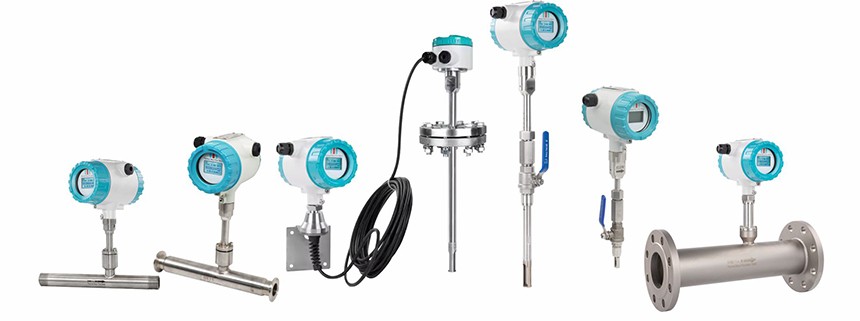
1.1 Thermal Mass Flow Meters (Most Widely Used)
Principle:
Based on the thermal diffusion principle. One sensor is heated while the other measures temperature. When air flows past, it carries heat away. The power required to maintain the temperature difference is proportional to the mass flow rate.
Direct Output:
Mass flow at standard conditions (Nm³/h, kg/h) — no extra pressure/temperature compensation.
Advantages:
-
High accuracy
-
Wide turndown ratio
-
Minimal pressure loss
-
Ideal for very low velocities (perfect for leak detection)
(Learn more in our guide to Thermal Flow Measurement Technologies.)
1.2 Vortex Flow Meters (Proven Classic Technology)
Principle:
A bluff body creates alternating vortices downstream. The vortex frequency is directly proportional to the flow velocity.
Output:
Volumetric flow (m³/h), requiring pressure and temperature compensation for mass flow.
Advantages:
-
Robust design
-
Wide working conditions
-
Good for general process control
Limitations:
-
Sensitive to pipeline vibration
-
Poor performance at low flow speeds
1.3 Differential Pressure Flow Meters (Orifice Plate, V-Cone, etc.)
Principle:
A constriction creates a pressure drop. The square root of this differential pressure correlates with flow rate.
Limitations:
-
Significant permanent pressure loss
-
Narrow measurement range
-
Complex installation requirements
This technology is gradually being replaced in energy-saving projects.
2. Key Selection Criteria: How to Choose the Right Compressed Air Flow Meter
Choosing a flow meter requires matching the instrument to the application, flow conditions, and installation environment.
2.1 Determine the Measurement Purpose
-
Energy management & billing → High-accuracy mass flow (thermal mass recommended)
-
Process monitoring → Thermal or vortex meters
-
Leak detection → Thermal meters with high low-flow sensitivity
2.2 Confirm Operating Conditions
-
Flow range: Should be within 30–80% of meter capacity
-
Pipe diameter: Determines insertion type vs inline type
-
Operating pressure & temperature: Typical 0.4–0.8 MPa in factories
-
Air quality: Additional filtration may be required
2.3 Evaluate the Installation Environment
-
Straight pipe runs: Follow recommended lengths (10D upstream, 5D downstream)
-
Vibration: Avoid vortex meters in high-vibration areas
-
Power & signal output: 24 VDC, 4–20 mA, Modbus, or HART as needed
3. Application Scenarios and Recommended Brands
High-Performance, Long-Term Stability
-
Brands: Siemens, Endress+Hauser
-
Use cases: Energy centers, critical control points, external billing
Energy Efficiency & System Auditing
-
Brands: Sierra Instruments
-
Use cases: Energy audits, leakage surveys, system optimization projects
Cost-Effective Monitoring
-
Brands: Chongqing Chuanyi, Aister Instrument
-
Use cases: Plant-level sub-metering, general process monitoring
.png)
4. Best Practices and Common Pitfalls
Best Practices
-
Maintain proper straight runs
-
Clean sensors periodically
-
Install measurement points hierarchically (main header, workshop entries, key branches)
Common Pitfalls
-
Choosing based on price alone → High pressure loss can cost more in long-term energy consumption
-
Ignoring minimum flow → Causes inaccurate night/off-peak data
-
Poor installation location → Proximity to valves/elbows distorts flow
Conclusion: Accurate Flow Measurement Drives Real Energy Savings
Compressed air is expensive, but accurate metering makes it manageable. By understanding the measurement principles, selecting the right flow meter, and avoiding common installation errors, companies can significantly improve energy efficiency, reduce waste, and gain greater control over their compressed air systems.
Whether you are upgrading your instrumentation, planning an energy audit, or building a smart factory, the right flow meter is an essential step toward achieving sustainable and measurable performance gains.
Share To:
Next Post:
News
- Why is the thermal gas mass flowmeter not affected by pressure strength and temperature?
- What to do when a thermal gas mass flow meter fails?
- How are thermal gas mass flow meters used? What are the applications?
- Under what circumstances is the gas measurement need to be regulated compensated vortex flowmeter
- Why Is The Aister Thermal Gas Mass Flowmeter So Popular ?
- Gas turbine flowmeter manufacturers explain their main advantages in measurement
- Gas turbine flowmeter manufacturer Aister instrument field experience summary
- Aister Instrument Empowerment Conference