


Thermal Mass Flow Meter Selection Guide: 6 Core Dimensions to Avoid Measurement Errors
2026-07-01
Thermal mass flow meters are widely used for the measurement of compressed air, natural gas, flue gas, and various process gases. However, due to the complex selection parameters, any mismatch can easily lead to measurement inaccuracy, incompatible working conditions, and high maintenance costs in actual industrial sites.
Drawing on years of experience in industrial fluid metering projects, Aister provides a standardized selection guide across six core dimensions: fluid media, pipe size, process conditions, installation, accuracy, and functionality.
1. Confirm Fluid Media and Match Sensor Material
The corrosiveness and cleanliness of different gases directly determine the lifespan of the sensor. It is crucial to match the probe material of the thermal mass flow meter accordingly:
-
Standard Industrial Gases: For general dry natural gas, nitrogen, and compressed air measurement, standard 316L stainless steel probes are recommended. They offer high cost-effectiveness and meet the vast majority of conventional working conditions.
-
Mildly Corrosive Gases: For high-sulfur blast furnace gas or acid-base exhaust gases, Hastelloy anti-corrosion probes are highly recommended to resist chemical erosion.
-
Highly Corrosive and Wet Gases: For moisture-laden, highly corrosive tail gases, PTFE-coated probes must be utilized to block aggressive fluids from damaging the sensor.
Anti-Drift Tip: If the gas contains heavy dust or particulates, it is recommended to install a pre-filter or dust removal component upstream to prevent zero drift caused by dust accumulation on the probe surface.
2. Choose the Structural Type Based on Pipe Size
The pipeline dimensions and onsite installation conditions dictate whether an inline or an insertion structure should be selected:
-
Inline Type (DN15 to DN200 Small-to-Medium Pipes): Calibrated as an entire pipe section at the factory, this type offers high measurement accuracy and excellent stability. It is ideal for internal factory energy audits and workshop-level cost accounting where precision is critical.
.png)
-
Insertion Type (DN200 and Above Large Pipes): Highly suitable for large air ducts, flues, and main gas pipelines. It supports hot-tapping online installation without stopping production or cutting pipes, drastically reducing installation and downtime costs for retrofitting projects.
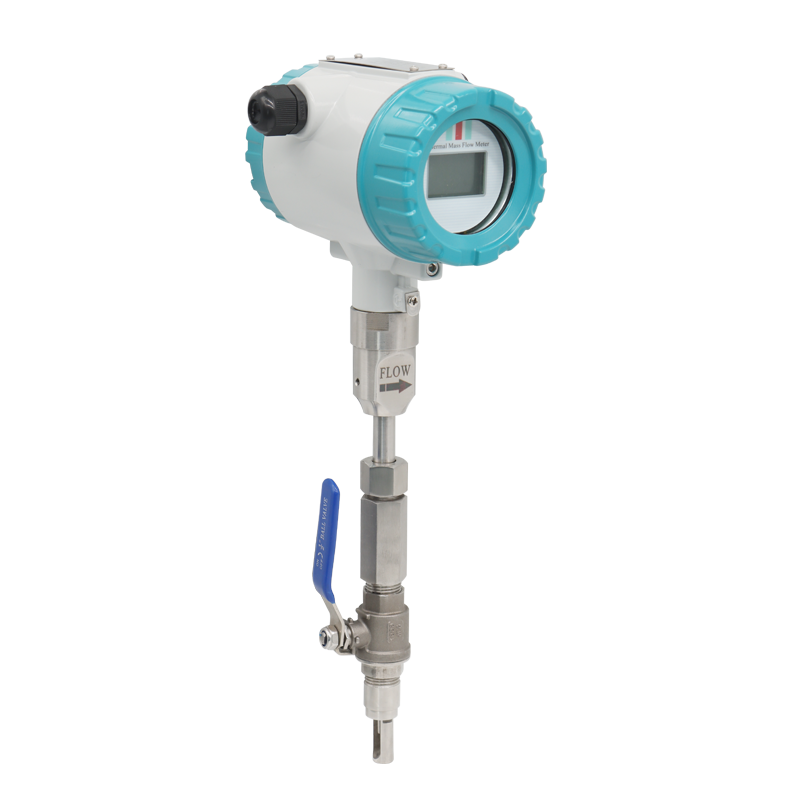
Special Conditions Note: For high-temperature, strong-vibration, or confined spaces, a remote (split) structure should be selected. Separating the sensor probe from the transmitter enclosure effectively protects electronic components from high heat and severe mechanical vibration.
3. Analyze Temperature, Pressure, and Flow Velocity Ranges
Before selection, actual onsite operating parameters must be fully clarified to verify the meter's flow range coverage:
-
Temperature Range: Conventional models support -40°C to 120°C. For high-temperature flue gas measurement, a customized high-temperature model up to 220°C is available.
-
Flow Velocity: The minimum flow velocity must not be lower than the meter's initial turndown limit. For processes with large gas fluctuations or intermittent production, a wide turndown ratio model of up to 100:1 is highly recommended to ensure no loss of data even under micro-leakage states. Aister's full series covers everything from micro-leakage to massive exhaust flows without data loss.
-
Pressure Rating: Standard structures are sufficient for atmospheric and low-pressure pipelines, while customized heavy-duty pressure-resistant structures are required for high-pressure process gases.
4. Define the Application to Determine Accuracy Grade
Balance accuracy requirements with procurement costs based on the ultimate business purpose:
-
Internal Energy Statistics & Pipeline Leak Detection: A standard accuracy of ±1.0% FS is recommended. It offers higher cost-effectiveness, perfectly meeting daily production control and trend analysis needs.
-
Flue Gas Environmental Monitoring, Energy Auditing, & Custody Transfer: A high-precision grade of ±0.5% FS should be chosen. This configuration comes with an official CMC calibration certification, ensuring the legal compliance and full traceability of your data.
5. Confirm Explosion-Proof and Ingress Protection (IP) Ratings
Industrial site safety is always the top priority. In hazardous environments such as chemical plants with natural gas, hydrogen, or biogas, an Ex d IIC T6 flameproof rating must be configured. For outdoor exposed or humid air ducts, an IP67 high protection enclosure should be chosen to withstand harsh environmental conditions.
Straight Pipe Requirement: Adequate upstream and downstream straight pipe runs must be reserved onsite. If the installation space is severely limited, a dedicated flow conditioner can be customized by Aister to eliminate measurement errors caused by flow turbulence.
6. Match the Automation System and Select Communication Outputs
To integrate seamlessly into your factory's digital management platform, select the appropriate output signal based on your host system:
-
Local & Basic Control: For local reading or connection to simple secondary instruments, pulse or 4-20mA analog outputs are available.
-
Medium-to-Large Modern Plants: For smart energy platforms and remote PLC monitoring, Modbus-RS485 communication comes as standard.
-
Complex Chemical Automation: Add a HART protocol option for convenient online asset management and parameter configuration.
-
Remote IoT Meter Reading: Can be equipped with an NB-IoT wireless module to achieve unmanned, smart grid monitoring.
7. Evaluate Total Cost and After-Sales Support
During long-term operation, the manufacturer's calibration capability and service efficiency are vital to your bottom line:
-
Pain Points of Import Brands: Expensive quotes, long delivery cycles, and severely delayed maintenance or spare parts support.
-
Risks of Low-End Workshops: Lack of professional calibration equipment. Products leave the factory without scientific verification, leading to severe zero drift over long-term operation.
-
Aister Manufacturing Capabilities: Equipped with an independent sonic nozzle calibration device, all meters undergo rigorous gradient calibration before factory dispatch. The price is only one-third of imported brands, while supporting non-standard customization and extended warranties, making it ideal for various chemical, factory, and energy projects.
Selection Logic Summary
First determine the gas medium and pipe size, then analyze the temperature, pressure, and flow velocity. Next, choose the accuracy grade based on your metering needs, match the features and communication outputs with your automation requirements, and finally compare the manufacturer's calibration capability and after-sales support.
Get Your 1-on-1 Customized Gas Metering Solution
A selection mismatch not only wastes thousands of dollars on idle equipment but also leads to distorted energy data and potential safety hazards. Aister's professional fluid engineers are now providing free process flow calculation services!
-
What We Offer for Free: Flow rate calculations based on your specific working conditions, 1-on-1 technical Q&A, and a tailored "Thermal Mass Flow Meter Selection Datasheet".
-
How to Reach Us: Please click on our "Contact Us" page to submit your pipe size and media parameters, or directly reach out to our application engineers via the official service hotline or corporate email. We promise to provide you with a detailed technical proposal and commercial quote within 1 business day!
Share To:
Next Post:
News
- Why is the thermal gas mass flowmeter not affected by pressure strength and temperature?
- What to do when a thermal gas mass flow meter fails?
- How are thermal gas mass flow meters used? What are the applications?
- Under what circumstances is the gas measurement need to be regulated compensated vortex flowmeter
- Why Is The Aister Thermal Gas Mass Flowmeter So Popular ?
- Gas turbine flowmeter manufacturers explain their main advantages in measurement
- Gas turbine flowmeter manufacturer Aister instrument field experience summary
- Aister Instrument Empowerment Conference