


Differential Pressure, Volume, or Thermal Mass? The Brutal Truth About Gas Flow Measurement
2026-05-13
"Is your gas flow meter leaking profits?"
Many industrial plants lose thousands of dollars annually—not because of actual leaks, but because of improper meter selection. Between "hidden" pressure drops and inaccurate temperature compensations, choosing the wrong technology is a costly gamble. Whether it's DP, PD, or Thermal Mass, every meter has a 'sweet spot' and a 'failure zone.' This 3-minute guide will show you how to stop guessing and start measuring with surgical precision.
Many industrial plants lose thousands of dollars annually—not because of actual leaks, but because of improper meter selection. Between "hidden" pressure drops and inaccurate temperature compensations, choosing the wrong technology is a costly gamble. Whether it's DP, PD, or Thermal Mass, every meter has a 'sweet spot' and a 'failure zone.' This 3-minute guide will show you how to stop guessing and start measuring with surgical precision.
1. Three Types of Gas Flow Meters: Core Working Principles
Understanding the physics behind each flow meter helps in selecting the right model for your application.
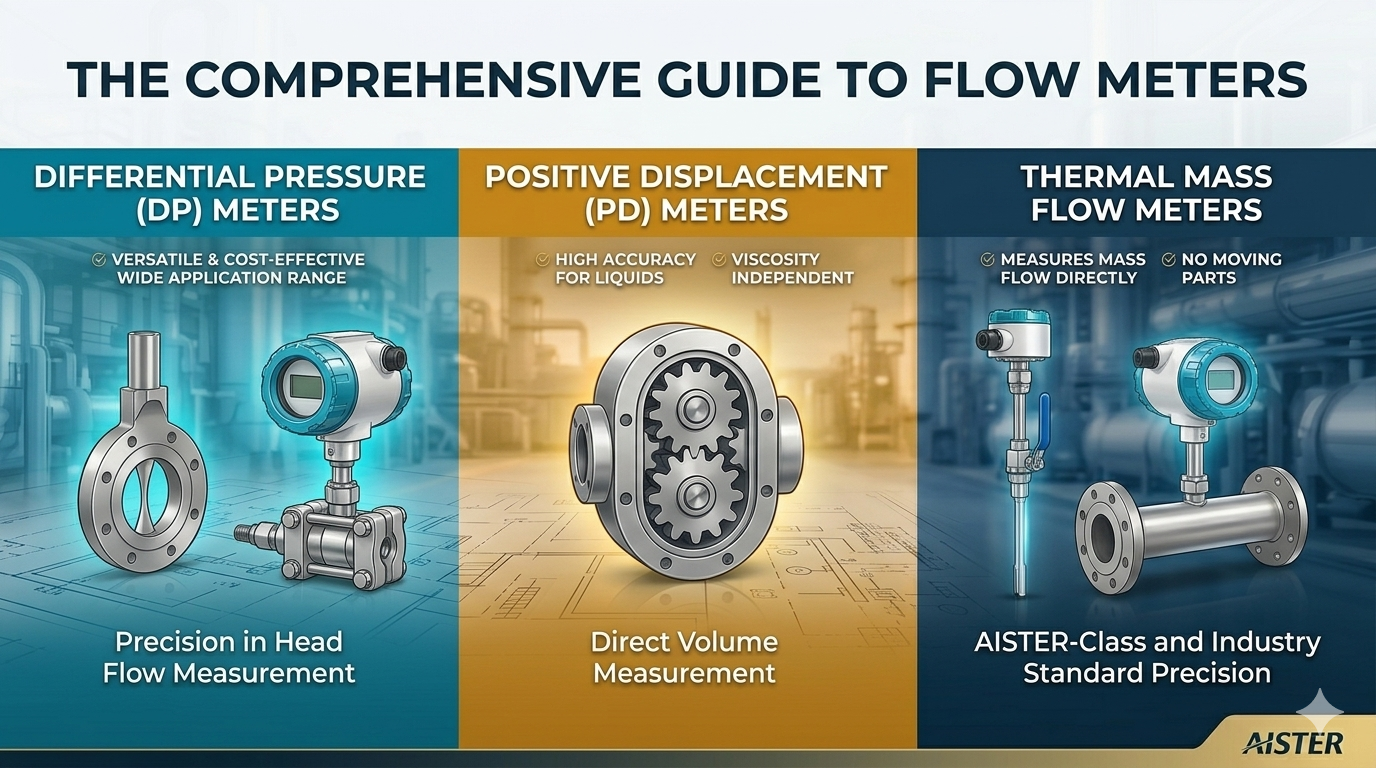
Differential Pressure (DP) Flow Meters
-
Working Principle: Utilizes a throttling device to create a pressure drop. The flow rate is calculated based on the square root of the differential pressure.
-
Typical Models: Annubar (averaging pitot tubes), Orifice Plate, Nozzle, Venturi, and V-Cone flow meters.
Positive Displacement (PD) Flow Meters
-
Working Principle: Measures the actual volume of gas by trapping it in a precision measuring chamber. It segments and counts the volumes to provide a totalized flow.
-
Typical Models: Roots flow meters, Waist-wheel, Precession Vortex, and Diaphragm gas meters.
Thermal Mass Flow Meters
-
Working Principle: Operates on the principle of thermal diffusion. It measures mass flow directly by monitoring the heat dissipation from a heated sensor, requiring no temperature or pressure (T/P) compensation.
-
Types: Insertion and Inline (Flanged) models.
2. Technical Comparison: Key Parameters & Performance
| Selection Criteria | Differential Pressure (DP) | Positive Displacement (PD) | Thermal Mass Flow |
| Accuracy | Moderate | High (Best for Billing) | High for Mass Flow |
| Pressure Loss | Significant | Low to Moderate | Negligible (Zero) |
| T/P Compensation | Required | Not required | Built-in / Not needed |
| Maintenance | Low (No moving parts) | High (Moving parts) | Moderate (Probe cleaning) |
| Cost | Budget-friendly | Premium | Mid-range |
Advantages & Disadvantages
-
DP Flow Meters: Highly durable and handles extreme temperatures/pressures, but has a limited turndown ratio and requires complex installation for compensation.
-
PD Flow Meters: Exceptional accuracy and wide rangeability, but sensitive to impurities and mechanical wear.
-
Thermal Mass: Perfect for low-velocity gas and direct mass measurement, but performance depends on consistent gas composition.
3. Industrial Applications & Selection Logic
How do you decide which gas flow meter is best for your project? Use the following selection logic:
When to choose Positive Displacement (PD)?
Best for Custody Transfer and trade settlement. If your application involves high-value clean gas in small to medium pipes where precision is the top priority.
When to choose Differential Pressure (DP)?
Ideal for Large Diameter Pipelines and harsh industrial environments. Choose this for flue gas, steam, or high-pressure natural gas when you need a robust, cost-effective solution.
When to choose Thermal Mass?
The go-to for Compressed Air & Nitrogen. If you need to measure mass flow, detect leaks (low flow sensitivity), or want a "plug-and-play" installation without external compensation sensors.
"Ready to Find Your Perfect Match?"
Skip the hours of research. Send us your operating parameters—Gas Type, Flow Range, and Pressure—and our team will generate a custom Technology Comparison Report tailored specifically for your facility within 24 hours.
Get your custom solution today: Email us at [sales@aistermeter.com] or click the [Request a Quote] below for a zero-obligation technical consultation.
Share To:
Previous Post:
Next Post:
News
- Why is the thermal gas mass flowmeter not affected by pressure strength and temperature?
- What to do when a thermal gas mass flow meter fails?
- How are thermal gas mass flow meters used? What are the applications?
- Under what circumstances is the gas measurement need to be regulated compensated vortex flowmeter
- Why Is The Aister Thermal Gas Mass Flowmeter So Popular ?
- Gas turbine flowmeter manufacturers explain their main advantages in measurement
- Gas turbine flowmeter manufacturer Aister instrument field experience summary
- Aister Instrument Empowerment Conference