


How to Choose a Reliable Fuel PD Flow Meter
2026-05-15
Do you know why your fuel business keeps losing profit for no obvious reason?
A fuel trader once used a cheap universal flow meter. The error was only 0.4%, but it secretly lost 2,800 liters of diesel every month.
Strangely, the meter still looked normal. No leakage, no breakdown. Most operators never realize they are losing money from the wrong meter selection.
Many people believe all oil flow meters are the same. This misunderstanding costs them thousands of dollars every year. Unsuitable meters drift easily, get stuck by impurities, and fail custody transfer inspections.
Piston positive displacement meters remain the best choice for gasoline and diesel measurement. But one mismatched parameter — flow range, pressure, or material — will turn your meter into a hidden loss trap.
Don’t let incorrect selection quietly eat your profits.
Don’t let incorrect selection quietly eat your profits.
If you are confused about meter models, certifications, or parameter matching, get in touch with us today. Our professional engineers provide free selection consultation to help you pick the most suitable fuel flow meter.
Get your custom solution today: Email us at [sales@aistermeter.com] or click the [Request a Quote] below for a zero-obligation technical consultation.
A fuel trader once used a cheap universal flow meter. The error was only 0.4%, but it secretly lost 2,800 liters of diesel every month.
Strangely, the meter still looked normal. No leakage, no breakdown. Most operators never realize they are losing money from the wrong meter selection.
Many people believe all oil flow meters are the same. This misunderstanding costs them thousands of dollars every year. Unsuitable meters drift easily, get stuck by impurities, and fail custody transfer inspections.
Piston positive displacement meters remain the best choice for gasoline and diesel measurement. But one mismatched parameter — flow range, pressure, or material — will turn your meter into a hidden loss trap.
Don’t let incorrect selection quietly eat your profits.
1. Identify Key Operating Parameters (“Must-Confirm” Section)
1. Medium Characteristics
- Type of medium: gasoline / diesel / kerosene / lubricating oil / chemical solvents? Is it flammable or explosive?
- Viscosity range: positive displacement flow meters are highly sensitive to viscosity. They are generally suitable for liquids in the range of 0.1–1000 mPa·s.
- If viscosity is too low (e.g., water), internal leakage may reduce accuracy.
- If viscosity is too high, pressure loss will become excessive.
- Cleanliness: Does the medium contain impurities or solid particles? If yes, a filter must be installed upstream (the accessory shown on the left side in the diagram is a filter). Otherwise, internal pistons may jam or wear out.
- Corrosiveness: Is the medium corrosive? If so, stainless steel (304/316L) models must be selected. Ordinary cast iron or cast aluminum is not suitable.
2. Flow Rate and Pipe Size
- Actual flow range: Determine minimum, normal, and maximum operating flow.
- Recommended selection:
- Normal flow should be 70%–85% of full scale
- Maximum flow should not exceed 95% of full scale
- Minimum flow should not be lower than 30% of full scale
This ensures both accuracy and service life.
- Recommended selection:
- Nominal diameter (DN): Match the pipe size, such as DN25, DN40, DN50, etc.
- Note that the flow meter size does not always need to match the pipeline exactly.
- For low-flow conditions, reducers are often used to install a smaller meter to improve measurement accuracy.
3. Pressure and Temperature
- Operating pressure: e.g., 1.6 MPa, 2.5 MPa. It must not exceed the rated working pressure of the flow meter, and pressure surges in the system should also be considered.
- Medium temperature: ambient / medium / high temperature.
- Standard models are typically rated from -20°C to 80°C.
- High-temperature media require specially designed high-temperature models.
2. Selection Based on Measurement and Application Requirements
1. Accuracy Class
- Trade settlement applications (e.g., oil depots, fuel stations):
- Must use Class 0.2 or 0.5 accuracy
- Requires metrology certification, explosion-proof certification, and legal traceability approval
- Process control / internal measurement:
- Class 1.0 accuracy is usually sufficient and more cost-effective
2. Output and Display Options
- On-site direct reading:
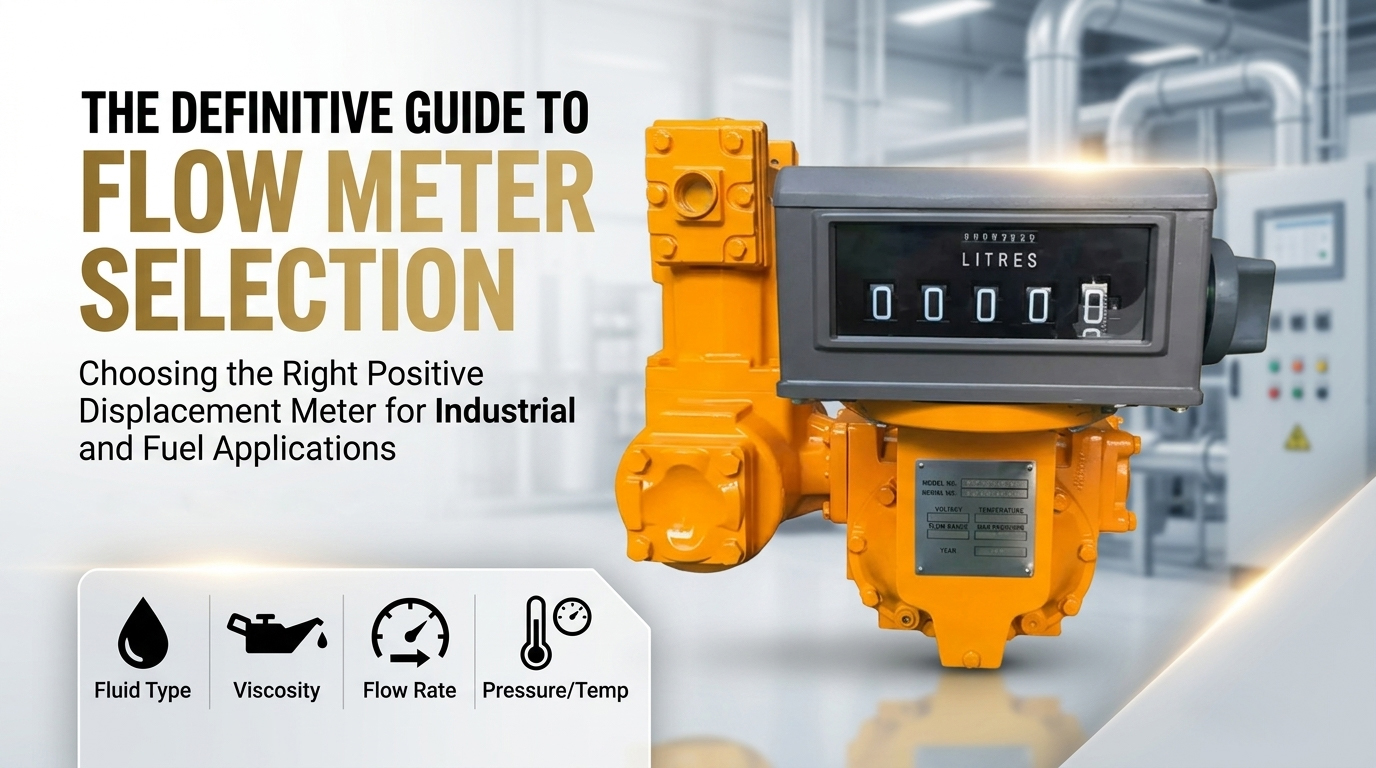
- Mechanical counter (as shown in the image)
- Can display cumulative flow without power supply
- Suitable for field environments without electricity
- Signal transmission:
- If connection to PLC or monitoring systems is required, choose models with pulse output, 4–20 mA, or RS485 communication
- Enables data acquisition and remote monitoring
3. Safety and Protection
- Explosion protection rating:
- Required in flammable and explosive environments (fuel stations, oil depots)
- Common ratings include Ex d IIB T4 / CT6, compliant with local safety standards
- Protection rating (IP):
- Outdoor installation should be IP65 or higher to prevent water and dust ingress
3. Final Selection by Application Scenario (Practical Guide)
| Application Scenario | Recommended Configuration | Key Pitfalls to Avoid |
|---|---|---|
| Fuel stations / tanker unloading | DN25/DN40, Class 0.2, explosion-proof type, with filter + gas eliminator | Must choose certified metering models; entrained air affects accuracy |
| Industrial lubricating oil / hydraulic oil measurement | DN15–DN50, Class 0.5, cast iron / aluminum alloy | High-viscosity fluids require low-pressure-loss design to avoid pipeline pressure issues |
| Chemical solvents / corrosive media measurement | 316L stainless steel body, corrosion-resistant seals | Confirm seal material compatibility (e.g., FKM/PTFE) to prevent swelling |
4. Selection Formula Reference
- Range ratio: Prefer a 10:1 to 20:1 turndown ratio to handle flow fluctuations.
- Example: if maximum flow is 10 m³/h and minimum is 1 m³/h, select a range of 1–12 m³/h.
- Pressure loss verification:
- Ensure the flow meter pressure drop does not exceed the allowable system pressure loss
- Otherwise, downstream equipment performance may be affected.
Don’t let incorrect selection quietly eat your profits.
If you are confused about meter models, certifications, or parameter matching, get in touch with us today. Our professional engineers provide free selection consultation to help you pick the most suitable fuel flow meter.
Get your custom solution today: Email us at [sales@aistermeter.com] or click the [Request a Quote] below for a zero-obligation technical consultation.
Share To:
Next Post:
News
- Why is the thermal gas mass flowmeter not affected by pressure strength and temperature?
- What to do when a thermal gas mass flow meter fails?
- How are thermal gas mass flow meters used? What are the applications?
- Under what circumstances is the gas measurement need to be regulated compensated vortex flowmeter
- Why Is The Aister Thermal Gas Mass Flowmeter So Popular ?
- Gas turbine flowmeter manufacturers explain their main advantages in measurement
- Gas turbine flowmeter manufacturer Aister instrument field experience summary
- Aister Instrument Empowerment Conference