


Stop Guessing Your Gas Flow: The 5-Minute Selection Checklist for 2026
2026-05-11
In the world of industrial instrumentation, precision isn't just a goal—it’s a requirement for safety, efficiency, and the bottom line. When it comes to measuring clean, high-velocity gases, Gas Turbine Flow Meters remain the industry standard.
However, "buying a meter" and "specifying the right solution" are two very different things. Here is a field-tested guide on how to select the right meter for your application.
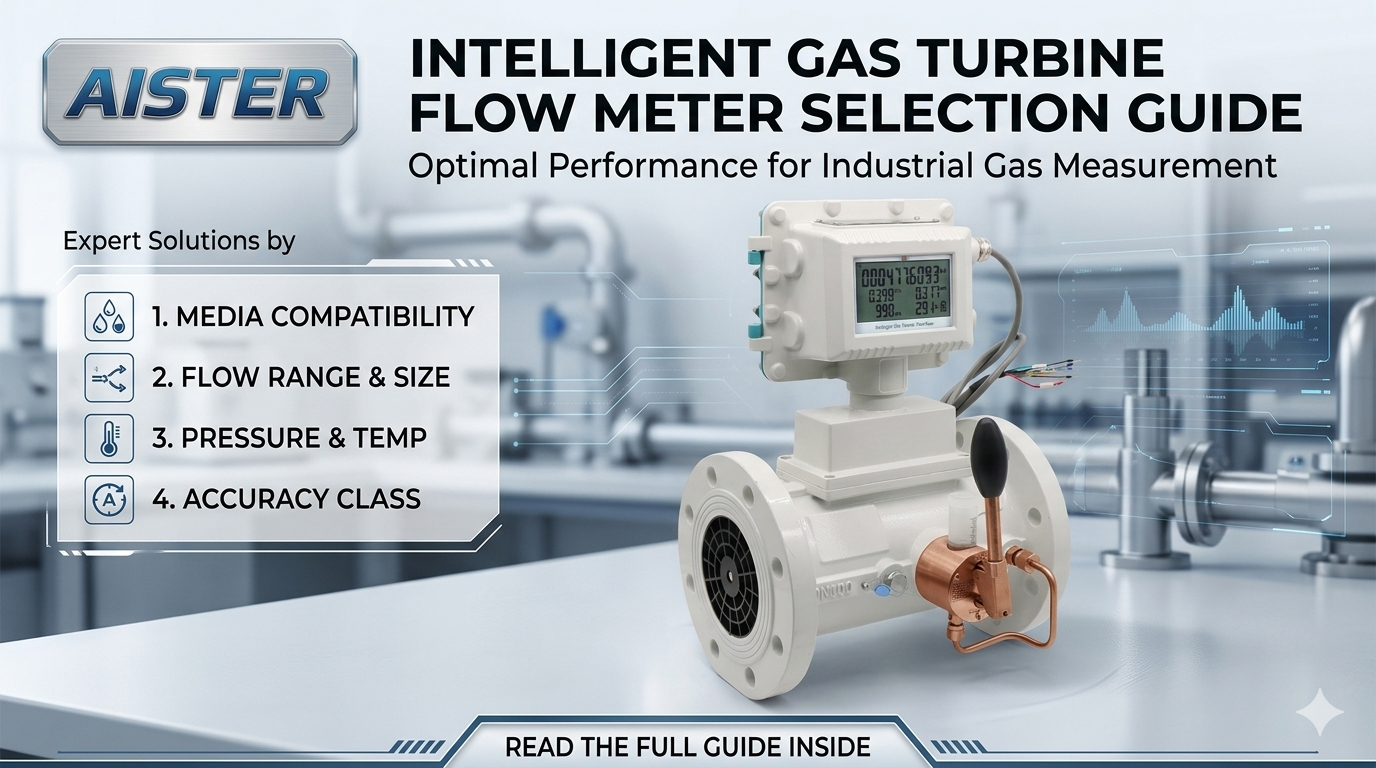
5 Critical Factors for Meter Selection
1. Know Your Media Chemistry
Turbine meters are precision instruments. While they excel with Natural Gas, Compressed Air, and Inert Gases (Nitrogen, Argon), they are sensitive to "dirty" gas.
-
The Pro Approach: If your process gas contains moisture or particulates, always specify an upstream filter or strainer. This prevents "rotor pepper," where debris erodes the leading edge of the turbine blades, leading to measurement drift.
2. Sizing Beyond the Pipe Diameter
A common rookie mistake is sizing a flow meter based solely on the existing pipe size.
-
Velocity is King: You must ensure your Normal Flow Rate falls within the meter’s "sweet spot" (typically 20% to 80% of the maximum range).
-
Low-Flow Sensitivity: Avoid running too close to the "low-flow cutoff." In the lower 10% of the range, mechanical friction begins to outweigh fluid momentum, causing the meter to under-report.
3. Custody Transfer vs. Process Control
Are you billing a client, or just checking boiler efficiency?
-
Fiscal/Custody Transfer: Requires high-tier, revenue-grade accuracy (±0.5% or better) with traceable calibration certificates.
-
Internal Balancing: A standard ±1.0% accuracy class is usually sufficient and more cost-effective for sub-metering and plant audits.
4. Installation & Flow Profiling
Turbine meters are sensitive to "swirl" caused by upstream elbows and valves.
-
The 10D/5D Rule: To ensure a fully developed flow profile, maintain at least 10 diameters of straight pipe upstream and 5 diameters downstream.
-
Hazardous Areas: In the oil & gas or chemical sectors, ensure your electronics are rated Explosion-Proof (Exd) or Intrinsically Safe (IS).
5. Smart Integration: T&P Compensation
Since gas is highly compressible, measuring "Actual" volume is rarely enough. To get an accurate mass-balance, look for meters with Integrated Temperature & Pressure (T&P) Compensation. This automatically converts Actual Cubic Feet (ACF) to Standard Cubic Feet (SCF), saving your PLC from complex math and reducing error margins.
Featured Solution: The Aister ATWG Series
When reliability in the field is non-negotiable, the ATWG Series by Aister Instrument has become a preferred choice for engineers globally. Built for high-performance and low maintenance, the ATWG series bridges the gap between laboratory precision and industrial durability.
Technical Performance Data
| Feature | Specification |
| Construction | 316L Stainless Steel Internals with Tungsten Carbide Bearings |
| Accuracy | Standard ±1.0% FS (High-precision ±0.5% FS available) |
| Repeatability | ≤ ±0.2% |
| Turndown Ratio | 20:1 Standard; Up to 40:1 for wide-range applications |
| Process Temp | Wide-spectrum capability: -40°C to 200°C |
| Communication | Pulse, 4-20mA, Modbus RS485 |
Why It Matters
The use of Tungsten Carbide bearings is a game-changer for longevity. It reduces mechanical drag and extends the service life in continuous-duty cycles, making it a "set-and-forget" solution for many plant managers.
Proven Track Record
Aister’s technology is currently deployed in over 160 countries, serving as the "digital eye" for industry leaders like Sinopec, PetroChina, BYD, and CATL. From municipal gas networks to high-stakes chemical reactors, the ATWG series delivers the data integrity required for modern energy management.
Choosing the right gas turbine meter is about balancing initial CAPEX with long-term OPEX. A cheaper meter that requires constant recalibration or fails due to bearing wear is never a bargain.
Every plant manager has that one ‘nightmare’ line where meters just don’t seem to last—whether it’s due to heavy pulsation, moisture, or extreme temperature swings. You shouldn’t have to guess your way through fluid dynamics.
Click to connect with our senior engineering team. Whether you need a quick P&ID review or a custom sizing calculation, we’re here to solve your toughest flow challenges with precision.
Share To:
Previous Post:
Next Post:
News
- Why is the thermal gas mass flowmeter not affected by pressure strength and temperature?
- What to do when a thermal gas mass flow meter fails?
- How are thermal gas mass flow meters used? What are the applications?
- Under what circumstances is the gas measurement need to be regulated compensated vortex flowmeter
- Why Is The Aister Thermal Gas Mass Flowmeter So Popular ?
- Gas turbine flowmeter manufacturers explain their main advantages in measurement
- Gas turbine flowmeter manufacturer Aister instrument field experience summary
- Aister Instrument Empowerment Conference