


Which Gas Turbine Flow Meter Brand Is Best? 2026 Top 10 Chinese & Global Manufacturers Compared
2026-07-21
1.How to Choose a Gas Turbine Flow Meter? Top 10 Brand Comparison & 2026 Buying Guide
2.Top 10 Gas Turbine Flow Meter Manufacturers: A Comprehensive Performance Comparison of Aister, TANCY, Endress+Hauser, and More
3.Best Gas Turbine Flow Meters for Natural Gas Custody Transfer: Technical Comparison of the Top 10 Brands and Their Ideal Applications
4.2026 Gas Turbine Flow Meter Selection Guide: Key Specifications, Pros & Cons of the World's Top 10 Brands
5.Gas Turbine Flow Meter Technology Explained: Brand Comparison & Selection Guide
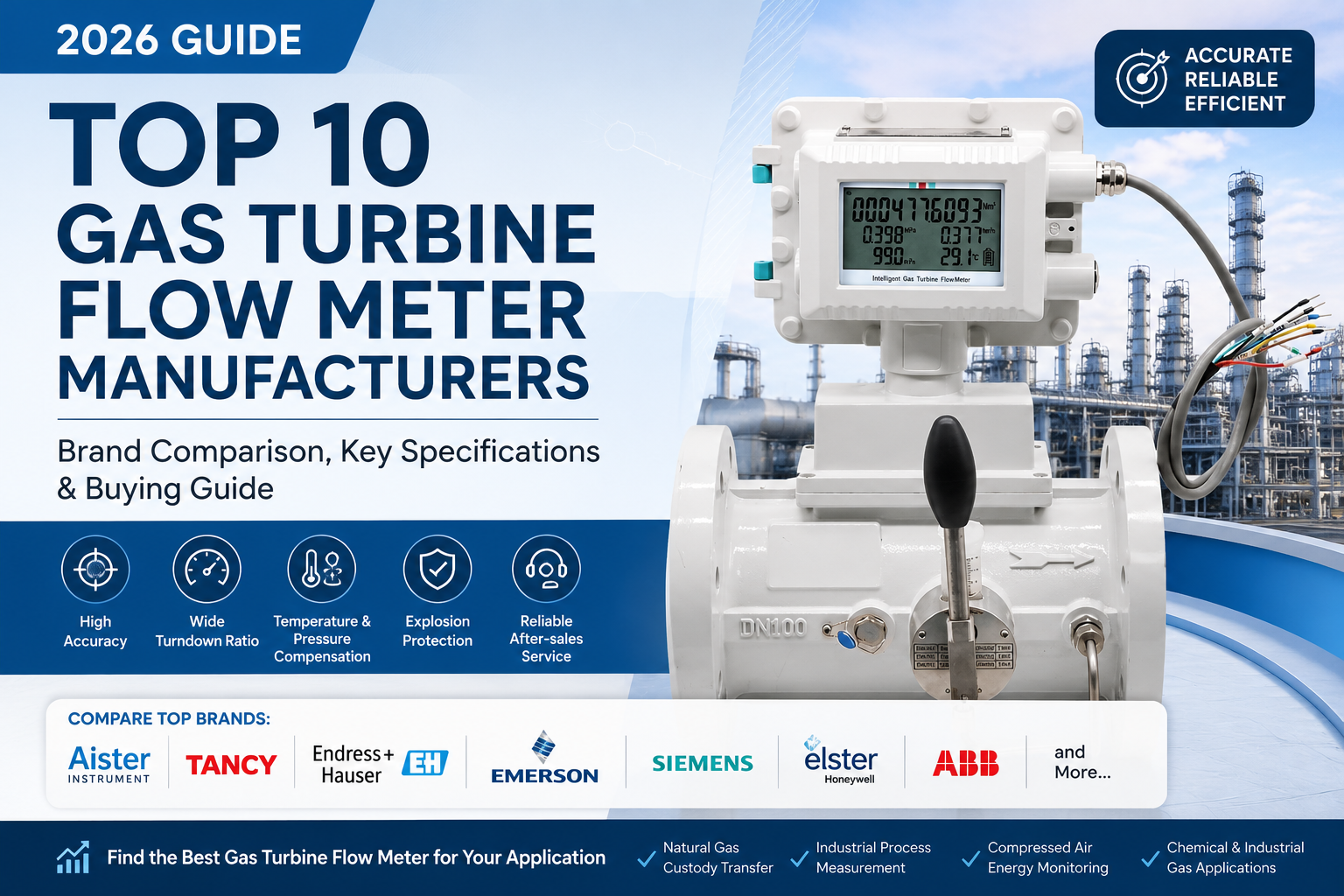
Gas turbine flow meters are among the most widely used instruments for measuring clean gases such as natural gas, compressed air, nitrogen, and other industrial gases. Thanks to their high accuracy, low pressure loss, and wide turndown ratio, they have become the preferred solution for custody transfer, energy management, and industrial process measurement.
However, with dozens of domestic and international manufacturers available, selecting the right gas turbine flow meter is not always straightforward. Buyers often ask questions such as:
- Are Chinese gas turbine flow meters comparable to international brands?
- Is integrated temperature and pressure compensation really necessary?
- Which manufacturers provide the most reliable after-sales support and spare parts?
- Which brand offers the best balance between performance and cost?
This guide compares 10 leading gas turbine flow meter manufacturers from four key perspectives:
- Technical capabilities
- Performance specifications
- Typical application scenarios
- Market reputation and overall value
Whether you are purchasing a meter for natural gas custody transfer, compressed air monitoring, or industrial gas measurement, this article will help you make an informed decision.
Gas Turbine Flow Meter Technology Overview
A gas turbine flow meter operates according to the principle of momentum transfer.
As gas flows through the flow conditioner, it accelerates and drives the turbine rotor to rotate. The rotational speed of the rotor is directly proportional to the gas velocity. A magnetic pickup sensor converts this rotational speed into electrical pulse signals, which are then processed to calculate the volumetric flow rate.
Modern smart gas turbine flow meters equipped with integrated temperature and pressure compensation can simultaneously measure:
- Gas flow rate
- Gas temperature
- Gas pressure
Using these parameters, the instrument automatically converts the operating volume into standard volume, providing significantly higher measurement accuracy for custody transfer and commercial billing applications.
Key Technology Differences Between International and Chinese Brands
Today's gas turbine flow meter market can generally be divided into three categories:
| Comparison Item | Global Premium Brands | Leading Chinese Brands | Budget Chinese Brands |
|---|---|---|---|
| Accuracy | ±0.5% to ±1.0% R | ±1.0% to ±1.5% R | ±1.5% to ±2.0% R |
| Turndown Ratio | 1:20 to 1:30 | 1:10 to 1:20 | Around 1:10 |
| Bearing Life | ≥5 years (premium imported bearings) | 3–5 years | 1–3 years |
| Temperature & Pressure Compensation | Standard | Standard | Optional |
| Explosion Protection | Ex d IIB T4–T6 | Ex d IIB T4–T6 | Typically Ex d IIB T4 |
| Typical Price Range | US$1,100–4,200+ | US$420–1,100 | US$200–560 |
What Matters Most When Choosing a Gas Turbine Flow Meter?
Although specifications vary among manufacturers, experienced engineers generally focus on the following factors:
1. Measurement Accuracy
Accuracy is especially critical for natural gas custody transfer, where billing depends on reliable flow measurement.
Typical accuracy classes include:
- ±0.5% R — High-end custody transfer
- ±1.0% R — Standard commercial gas measurement
- ±1.5% R or above — General industrial monitoring
2. Turndown Ratio
A wider turndown ratio allows the meter to maintain accuracy over a broader flow range.
For example:
- 1:10 is suitable for relatively stable gas consumption.
- 1:20 or 1:30 performs much better when gas demand fluctuates significantly throughout the day.
Applications with highly variable flow—such as city gas distribution networks, boilers, or food processing plants—benefit greatly from a larger turndown ratio.
3. Temperature & Pressure Compensation
Because gas is compressible, changes in temperature and pressure directly affect measured volume.
For custody transfer applications, integrated temperature and pressure compensation is considered essential. Without it, volume measurement errors can become substantial under changing operating conditions.
4. Bearing Quality
The bearings are the core moving components of a gas turbine flow meter.
Premium imported bearings typically provide:
- Lower starting flow rate
- Better repeatability
- Reduced friction
- Longer service life
- Lower maintenance costs
5. Explosion Protection Certification
For applications involving:
- Natural gas
- LPG
- Petrochemical plants
- Chemical processing
an explosion-proof rating such as Ex d IIB T6 is generally required to ensure safe operation.
6. After-Sales Support & Spare Parts Availability
Many buyers focus only on purchase price, but long-term operating costs are equally important.
Key considerations include:
- Spare parts availability
- Calibration services
- Technical support
- On-site commissioning
- Repair response time
- Delivery lead time
These factors often determine the total cost of ownership over the instrument's service life.
Top 10 Gas Turbine Flow Meter Manufacturers: In-Depth Brand Review

1. Aister Instrument (Shanghai, China)
Product Series
Aister's ATWG Series Gas Turbine Flow Meter is available in sizes from DN50 to DN400, with popular models including ATWG-DN80, ATWG-DN100, and ATWG-DN150. These meters are widely used for natural gas custody transfer, compressed air monitoring, and industrial gas measurement.
.png)
Key Features
The ATWG Series is equipped with high-precision imported stainless-steel instrument bearings, providing a low starting flow rate, excellent repeatability, and long-term measurement stability.
An integrated temperature and pressure compensation system continuously measures process conditions and automatically converts operating volume into standard volume, eliminating the need for an external flow computer in most applications.
The instrument features a low-power electronic design with dual power supply options:
- Built-in lithium battery (up to 5 years of operation)
- External 24 VDC power supply
Multiple output options are available, including:
- Pulse output
- 4–20 mA analog output
- RS485 (Modbus RTU)
- Remote GPRS data transmission (optional)
Aister also utilizes an optimized flow straightening structure, allowing the meter to maintain stable measurement performance even when ideal straight pipe lengths are difficult to achieve. A sealed dust-proof bearing chamber further minimizes contamination and extends bearing life.
Advantages
- High measurement accuracy (up to ±1.0% R)
- Wide turndown ratio up to 1:30
- Low pressure loss
- Excellent repeatability
- Integrated temperature and pressure compensation
- 180° rotatable electronic display for easier reading
- Explosion-proof rating: Ex d IIB T6
- Protection class: IP65
- Individually calibrated before shipment
- Fast spare parts supply and responsive after-sales service
- Excellent overall cost-performance ratio
Limitations
Compared with premium international brands, Aister currently offers fewer advanced diagnostic functions, such as predictive maintenance and continuous instrument health monitoring. However, for most industrial users, these features are not essential and have little impact on measurement performance.
Recommended Applications
- Natural gas custody transfer
- City gas distribution networks
- Compressed air energy monitoring
- Nitrogen and inert gas measurement
- Chemical plants
- Industrial gas distribution systems
- Energy management projects
.png)
Market Position
Aister has become one of China's leading gas turbine flow meter manufacturers by combining reliable performance, competitive pricing, and responsive technical support.
For buyers seeking dependable measurement accuracy without the premium price of imported brands, the ATWG Series represents one of the strongest value propositions currently available.
Overall Rating: ⭐⭐⭐⭐⭐
2. TANCY (China)
Product Series
TANCY's flagship TBQZ Series Gas Turbine Flow Meter primarily covers DN80–DN400 and is particularly well known for large-diameter natural gas applications.
Representative models include:
- TBQZ-II-DN100
- TBQZ-II-DN200
Key Features
TANCY is one of China's longest-established manufacturers specializing in gas turbine flow meters.
The TBQZ Series adopts a dual-rotor design capable of achieving ±1.0% R accuracy. Integrated temperature and pressure compensation is available as standard, and certain models support prepaid IC card systems commonly used by city gas utilities.
Advantages
- Strong brand recognition in China's gas industry
- Mature nationwide distribution network
- Extensive experience in utility gas projects
- Proven reliability for large-diameter custody transfer
- Good reputation among municipal gas companies
Limitations
Compared with newer manufacturers, TANCY's product development cycle is relatively conservative.
Several intelligent features—such as remote diagnostics, predictive maintenance, and advanced self-diagnostic capabilities—remain less sophisticated than those offered by some newer competitors.
Additionally:
- Small-diameter models (below DN50) are less cost-effective.
- Service response may be slower in remote regions.
Recommended Applications
- City gas transmission and distribution
- Natural gas custody transfer
- Industrial boiler gas measurement
- Municipal gas utility projects
Market Position
TANCY remains one of the dominant suppliers in China's gas utility sector, particularly for municipal natural gas projects requiring proven long-term reliability.
Overall Rating: ⭐⭐⭐⭐☆
3. Endress+Hauser (Switzerland)
Product Portfolio
Endress+Hauser is recognized globally as one of the most respected names in industrial instrumentation.
For gas flow measurement, its portfolio includes the Proline family together with other high-end flow measurement solutions designed for demanding industrial applications and custody transfer projects.
Key Features
Endress+Hauser products deliver measurement accuracy of up to ±0.5% R, with a turndown ratio reaching 1:30.
The instruments feature precision-machined turbine rotors and premium custom bearings designed for long-term stability.
One of the company's most distinctive technologies is Heartbeat Technology, an integrated diagnostics platform that continuously monitors instrument condition and generates comprehensive health reports without interrupting operation.
Advantages
- Industry-leading measurement accuracy
- Exceptional long-term stability
- Heartbeat Technology enables predictive maintenance
- Global engineering support network
- Strong international reputation
- Comprehensive certifications for international projects
Limitations
The primary drawback is cost.
Compared with Chinese manufacturers, Endress+Hauser gas turbine flow meters typically cost five to ten times more.
Additional considerations include:
- Spare parts often require 4–8 weeks for delivery.
- Large or less common sizes may have extended lead times.
- Commissioning generally requires trained engineers.
- Total lifecycle costs are significantly higher.
Recommended Applications
- LNG receiving terminals
- International EPC projects
- Oil & gas facilities
- Large petrochemical plants
- High-accuracy custody transfer stations
- Projects requiring international certifications
Market Position
Endress+Hauser continues to set the benchmark for premium industrial flow measurement worldwide.
For projects where measurement accuracy, reliability, and international certification take priority over budget, it remains one of the best available choices.
However, for many standard industrial applications, the performance advantage may not justify the substantially higher investment.
Overall Rating: ⭐⭐⭐⭐☆
4. Emerson (United States)
Product Portfolio
Emerson is one of the world's leading suppliers of flow measurement solutions. Within its extensive portfolio, the Daniel® Gas Turbine Flow Meter is particularly well known in the oil & gas industry for custody transfer and high-accuracy gas measurement.
Other Emerson flow technologies, including Micro Motion® and Rosemount™, further strengthen its position as a comprehensive instrumentation provider.
Key Features
Daniel gas turbine flow meters deliver measurement accuracy of up to ±0.5% R with a 1:20 to 1:30 turndown ratio.
Designed with ultra-low-friction precision bearings and carefully balanced turbine rotors, these meters provide excellent performance even under low-flow conditions.
Many models are equipped with an integrated flow computer supporting:
- Temperature compensation
- Pressure compensation
- Compressibility correction
- Multiple communication protocols
- Advanced diagnostics
Advantages
- Exceptional measurement accuracy
- Outstanding long-term stability
- Industry-leading bearing technology
- Wide turndown ratio for fluctuating flow conditions
- Predictive bearing wear monitoring
- Comprehensive custody transfer certifications
- Preferred brand for oil & gas projects worldwide
Limitations
Emerson products are positioned at the premium end of the market.
Potential buyers should consider:
- Purchase prices typically 5–10 times higher than Chinese alternatives
- Delivery times of 6–12 weeks for imported products
- Higher software and system integration costs
- Specialized technical support often required for commissioning
For smaller industrial projects, the additional investment may not provide proportional benefits.
Recommended Applications
- Oil & gas production
- Natural gas transmission pipelines
- LNG facilities
- Petrochemical complexes
- High-value custody transfer stations
- International EPC projects
Market Position
Daniel gas turbine flow meters have become one of the industry's reference standards for custody transfer.
If maximum accuracy, reliability, and international compliance are essential, Emerson remains one of the strongest choices available.
Overall Rating: ⭐⭐⭐⭐☆
5. Siemens (Germany)
Product Portfolio
Siemens offers gas flow measurement solutions under its SITRANS® product family.
While gas turbine flow meters are only one part of Siemens' extensive automation portfolio, they integrate seamlessly with the company's digital control systems.
Key Features
Siemens emphasizes digitalization and Industrial 4.0 connectivity.
Typical features include:
- PROFINET communication
- Integration with Siemens PCS 7 and other DCS platforms
- Remote configuration
- Firmware upgrades
- Digital asset management
Measurement accuracy typically reaches ±1.0% R, with a 1:20 turndown ratio.
Advantages
- Excellent compatibility with Siemens automation systems
- Powerful digital communication capabilities
- Reliable global service network
- Strong engineering support for large industrial facilities
Limitations
Gas turbine flow meters are not Siemens' primary flow measurement product line.
Compared with competitors, buyers may notice:
- Slower product updates
- Higher pricing than most domestic manufacturers
- Limited local distributor coverage in smaller markets
- Less competitive performance-to-price ratio for standalone flow measurement projects
Recommended Applications
- Chemical plants
- Steel mills
- Industrial utility systems
- Energy management projects
- Facilities already using Siemens automation platforms
Market Position
Siemens is an outstanding automation company.
However, when considering gas turbine flow meters alone, its competitive advantage is strongest in projects where seamless integration with Siemens control systems is a priority.
Overall Rating: ⭐⭐⭐⭐☆
6. Elster (Honeywell)
Product Portfolio
Originally founded in Germany and now operating under Honeywell, Elster has more than 160 years of experience in gas measurement.
Its gas turbine flow meters have earned an excellent reputation in natural gas transmission and distribution systems worldwide.
Key Features
Elster utilizes a proprietary suspended bearing design that minimizes bearing wear while extending service intervals.
Typical specifications include:
- Accuracy: ±1.0% R
- Turndown ratio: 1:20
- High long-term measurement stability
- Proven reliability in gas utility applications
Advantages
- Extensive experience in gas metering
- Trusted by utility companies worldwide
- Long bearing service life
- Strong engineering heritage
- Access to Honeywell's global supply chain
Limitations
Since becoming part of Honeywell, portions of the product portfolio have gradually been consolidated.
Potential buyers should also consider:
- Higher purchase costs
- Expensive replacement parts
- Longer lead times
- Dealer-based sales channels in many regions
- Limited price transparency
A complete bearing replacement kit can cost several thousand US dollars depending on the model.
Recommended Applications
- City gas distribution stations
- Pressure regulating and metering stations
- Commercial natural gas facilities
- Large industrial gas users
Market Position
Elster remains one of Europe's most respected gas metering brands.
Although its market share in Asia is smaller than in Europe and North America, it continues to be a preferred choice for many utility companies.
Overall Rating: ⭐⭐⭐⭐☆
7. ABB (Switzerland)
Product Portfolio
ABB provides gas flow measurement solutions as part of its broader process automation portfolio.
Representative products include the Sensyflow® series, which emphasizes reliable industrial gas measurement and automation integration.
Key Features
ABB instruments employ dual-channel signal processing to reduce the effects of vibration and improve measurement stability.
Typical specifications include:
- Accuracy: ±1.0% R
- Turndown ratio: 1:20
- Support for Modbus, PROFIBUS, and Foundation Fieldbus
- Reliable operation in demanding industrial environments
Advantages
- Strong reputation in industrial automation
- Stable performance under vibration
- Excellent communication protocol support
- Comprehensive automation ecosystem
Limitations
Gas turbine flow meters represent only a small portion of ABB's instrumentation business.
Compared with dedicated gas flow meter manufacturers:
- Product selection is more limited
- Technical support varies by region
- Purchase costs remain significantly higher than domestic alternatives
- Performance improvements may not justify the higher investment for many users
Recommended Applications
- Petrochemical plants
- Power generation
- Industrial gas distribution
- Process automation systems
Market Position
ABB is recognized globally for process automation excellence.
Its gas turbine flow meters are dependable industrial instruments, although they are generally not considered the first choice when buyers focus specifically on gas turbine flow meter technology.
Overall Rating: ⭐⭐⭐⭐☆
8. CNiM (China)
Product Series
CNiM offers the CN-LWQ Series Gas Turbine Flow Meter, primarily covering pipe sizes from DN50 to DN200. The series is positioned as an economical solution for general industrial gas flow measurement.
Key Features
The CN-LWQ Series features a straightforward mechanical design based on mature turbine flow meter technology. Most core components are sourced from external suppliers, helping to reduce manufacturing costs.
Typical specifications include:
- Accuracy: ±1.5% R
- Turndown ratio: 1:10
- Standard pulse output
- Optional temperature and pressure compensation
For applications where high precision is not required, the meter provides a practical and cost-effective solution.
Advantages
- Competitive pricing
- Simple installation and operation
- Suitable for basic industrial monitoring
- Affordable maintenance costs
Entry-level models are typically priced below US$300, making them attractive for projects with limited budgets.
Limitations
Compared with higher-end manufacturers, several limitations should be considered:
- Limited proprietary technology
- Bearings and turbine rotors are largely outsourced
- Narrow 1:10 turndown ratio
- Greater measurement deviation under fluctuating flow conditions
- Temperature and pressure compensation is optional rather than standard
- Spare parts availability and after-sales support may vary by region
- Product consistency between production batches can differ
As a result, the CN-LWQ Series is generally not recommended for custody transfer or applications requiring long-term measurement stability.
Recommended Applications
- General industrial gas monitoring
- Factory utility management
- Internal energy consumption analysis
- Non-billing gas measurement
Market Position
CNiM primarily competes in the entry-level market by offering affordable pricing rather than premium performance.
For users whose primary concern is minimizing initial investment, it can be a reasonable option.
Overall Rating: ⭐⭐⭐⭐☆
9. Chuanyi (China)
Product Series
Chuanyi manufactures the CY-LWQ Series Gas Turbine Flow Meter, available in sizes from DN50 to DN300.
The company is one of China's established state-owned instrumentation manufacturers, offering a broad portfolio of industrial automation products.
Key Features
Gas turbine flow meters represent only one segment of Chuanyi's extensive instrumentation business.
Typical specifications include:
- Accuracy: ±1.5% R
- Turndown ratio: 1:10–1:15
- Conventional industrial communication options
- Suitable for standard industrial gas measurement
Advantages
- Strong reputation among state-owned enterprises
- Comprehensive instrumentation product portfolio
- Ability to supply integrated automation solutions
- Convenient regional service network, particularly in Southwest China
Limitations
Compared with manufacturers specializing exclusively in gas flow measurement, Chuanyi invests fewer research and development resources in turbine flow meter technology.
Potential drawbacks include:
- Slower product innovation
- Limited intelligent diagnostic features
- Relatively narrow turndown ratio
- Longer delivery times than many private manufacturers
Recommended Applications
- Industrial gas measurement
- Chemical plants
- Municipal utilities
- Internal process monitoring
- Projects requiring complete automation packages
Market Position
Chuanyi enjoys a solid reputation in China's industrial automation market.
Its gas turbine flow meters are suitable for conventional industrial applications but are generally not positioned as premium products for demanding custody transfer projects.
Overall Rating: ⭐⭐⭐☆☆
10. Q&T Instrument (China)
.png)
Product Series
Q&T offers the QTLWQ Series Gas Turbine Flow Meter, which has gained market presence primarily in Northern China.
The product line focuses on economical solutions for basic industrial flow measurement.
Key Features
Typical specifications include:
- Accuracy: ±1.5% to ±2.0% R
- Turndown ratio: 1:10
- Standard pulse output
- Optional temperature and pressure compensation
The series emphasizes affordability over advanced functionality.
Advantages
- Highly competitive pricing
- Simple product configuration
- Suitable for budget-sensitive projects
- Easy installation
Entry-level models may cost as little as US$200–300.
Limitations
Buyers should carefully evaluate several factors before selection:
- Product consistency is less stable than higher-end competitors
- Higher reported field failure rates
- Shorter bearing service life
- Limited proprietary technology
- Slower after-sales support outside Northern China
- Some models may not be certified for custody transfer applications
These factors can significantly increase maintenance costs over the equipment's lifetime.
Recommended Applications
- Small manufacturing facilities
- Internal utility monitoring
- Non-critical industrial measurement
- Basic energy consumption estimation
Market Position
Q&T competes primarily on price.
While it can satisfy basic measurement requirements, it is generally not the preferred choice for projects demanding high accuracy, long service life, or comprehensive technical support.
Overall Rating: ⭐⭐⭐☆☆
Overall Brand Comparison
| Rank | Brand | Accuracy | Turndown Ratio | Temperature & Pressure Compensation | Explosion Protection | Reference Price | Recommended Applications | Positioning |
|---|---|---|---|---|---|---|---|---|
| 1 | Aister Instrument | ±1.0% R | 1:30 | Standard | Ex d IIB T6 | US$420–1,100 | Custody Transfer / Process Measurement | Best Value Chinese Brand |
| 2 | TANCY | ±1.0% R | 1:20 | Standard | Ex d IIB T6 | US$560–1,400 | Municipal Gas Utilities | Leading Domestic Brand |
| 3 | Endress+Hauser | ±0.5% R | 1:30 | Standard | Ex d IIB T6 | US$2,800–7,000+ | High-End Custody Transfer / EPC Projects | Premium Global Brand |
| 4 | Emerson | ±0.5% R | 1:30 | Standard | Ex d IIB T6 | US$3,500–8,500+ | Oil & Gas / Long-Distance Pipelines | Industry Benchmark |
| 5 | Siemens | ±1.0% R | 1:20 | Standard | Ex d IIB T4 | US$2,100–5,600+ | Chemical Plants / DCS Integration | Automation Leader |
| 6 | Elster (Honeywell) | ±1.0% R | 1:20 | Standard | Ex d IIB T6 | US$2,800–7,000+ | Natural Gas Distribution | Utility Metering Specialist |
| 7 | ABB | ±1.0% R | 1:20 | Standard | Ex d IIB T6 | US$1,700–4,200+ | Process Control / Power Industry | Process Automation Brand |
| 8 | CNiM | ±1.5% R | 1:10 | Optional | Ex d IIB T4 | US$420–1,100 | General Industrial Monitoring | Entry-Level Chinese Brand |
| 9 | Chuanyi | ±1.5% R | 1:10–1:15 | Partially Optional | Ex d IIB T4 | US$420–1,100 | State-Owned Enterprises / Southwest China | Mid-Low-End Industrial Brand |
| 10 | Q&T Instrument | ±1.5%–2.0% R | 1:10 | Optional | Ex d IIB T4 (varies by model) | US$420–1,100 | Internal Energy Monitoring | Budget Brand |
Frequently Asked Questions (FAQ)
Q1. Are Chinese Gas Turbine Flow Meters Comparable to Imported Brands? Are They Reliable for Custody Transfer?
Leading Chinese manufacturers such as Aister and TANCY have achieved performance comparable to most international brands in the ±1.0% R accuracy class. The primary differences now lie in added-value features such as bearing service life, advanced self-diagnostics, and predictive maintenance.
For standard 1.0 accuracy class natural gas custody transfer, leading Chinese brands fully satisfy operational requirements while costing only one-fifth to one-tenth the price of imported products. They also offer faster spare parts availability and more responsive local technical support.
Q2. Is Temperature and Pressure Compensation Necessary? How Much Error Can Occur Without It?
Yes—especially for custody transfer applications.
Because gas is a compressible medium, changes in temperature and pressure directly affect the measured gas volume. A gas turbine flow meter used for commercial billing should always include integrated temperature and pressure compensation.
For example:
- A temperature difference between 30°C in summer and –10°C in winter may result in approximately 7% volume measurement error if compensation is not applied.
- If pipeline pressure decreases from 0.20 MPa to 0.15 MPa (a 25% change), the resulting measurement deviation can approach 25% without pressure compensation.
Therefore, gas turbine flow meters without temperature and pressure compensation should only be used for general process monitoring rather than custody transfer.
Q3. Should I Choose a 1:10 or 1:20 Turndown Ratio?
The turndown ratio determines the flow range over which the meter can maintain its specified accuracy.
- If gas consumption remains relatively stable—such as in a factory operating continuously 24 hours a day—a 1:10 turndown ratio is generally sufficient.
- If gas demand fluctuates significantly—such as cafeteria kitchens, intermittent boiler operation, or municipal gas networks with large day/night demand variations—a 1:20 or higher turndown ratio is recommended.
Otherwise, measurement errors may increase noticeably during low-flow operating conditions.
The Aister ATWG Series offers a 1:30 turndown ratio, one of the widest ranges currently available among comparable Chinese gas turbine flow meters.
Q4. What Certifications Should Be Required When Purchasing a Gas Turbine Flow Meter?
For custody transfer applications, the instrument must have a CPA (Pattern Approval Certificate for Measuring Instruments); otherwise, it cannot be used for legally regulated trade measurement.
Additional certifications and documents to verify include:
- Explosion-proof Certificate (mandatory for gas and chemical applications; Ex d IIB T6 is widely accepted)
- Factory Calibration Certificate (provided with each instrument)
- Third-Party Calibration Report (commonly required for engineering acceptance and project commissioning)
Q5. How Often Should a Gas Turbine Flow Meter Be Calibrated? Are Spare Parts Readily Available?
The recommended calibration interval depends on the application's accuracy requirements, operating conditions, and local regulatory requirements.
As a general industry practice:
- Custody transfer applications: Calibration is typically recommended every 1–2 years, or in accordance with local regulations and contractual requirements.
- General industrial process monitoring: Calibration intervals of 2–3 years are often sufficient, provided the meter continues to perform within the required accuracy.
Because gas turbine flow meters contain precision moving components, the primary wear parts include:
- Bearings
- Turbine rotor
- Sealing components
Imported brands generally offer longer bearing service life but often have higher spare parts costs and longer delivery lead times. For example, a replacement bearing kit for some imported models can cost more than US$1,400, depending on the manufacturer and model.
In comparison, leading Chinese manufacturers typically provide shorter lead times and more cost-effective spare parts. Aister maintains dedicated spare parts inventory, allowing most critical replacement components to be shipped within 48 hours, helping minimize downtime and maintenance costs.
Q6. Can a Gas Turbine Flow Meter Be Integrated into a Factory DCS System?
Yes.
Most mid-range and high-end gas turbine flow meters are equipped with:
- RS485 / Modbus communication
- 4–20 mA analog output
Using the Modbus RTU protocol, they can be integrated with mainstream DCS platforms such as:
- Siemens PCS 7
- SUPCON ECS-700
- HOLLiAS MACS
The Aister ATWG Series also supports optional GPRS remote data transmission, making it suitable for centralized energy management and remote meter reading systems.
Q7. What Is the Typical Price Difference Between Domestic and Imported DN80 and DN150 Gas Turbine Flow Meters?
Using DN80 as an example:
- Chinese brands (Aister, TANCY, etc.): approximately US$420–850
- Imported brands (Endress+Hauser, Emerson, etc.): approximately US$2,100–4,200
For DN150:
- Chinese brands: approximately US$850–1,700
- Imported brands: approximately US$3,500–8,500
For the same pipe size and comparable specifications, imported gas turbine flow meters typically cost five to ten times more than leading Chinese alternatives.
Q8. Can a Gas Turbine Flow Meter Measure Gas Containing Moisture or Oil?
Generally, no.
Gas turbine flow meters require relatively clean gas because their rotating turbine structure is sensitive to contaminants.
Liquids, oil mist, or solid particles can:
- Accelerate bearing wear
- Cause turbine rotor blockage
- Reduce measurement accuracy
- Shorten service life
If gas cleanliness cannot be guaranteed, it is recommended to:
- Install a filter upstream of the flow meter, or
- Consider using a Vortex Flow Meter or Thermal Mass Flow Meter, both of which have no moving parts and are more tolerant of contaminated gas.
Selection Recommendations
Choosing the right gas turbine flow meter depends on your application, required accuracy, project budget, and operating conditions. The following recommendations can help simplify your selection process.
| Application | Recommended Solution | Why It's Recommended |
|---|---|---|
| Natural Gas Custody Transfer (Accuracy Class 1.0) | ✅ Aister ATWG Series | ±1.0% R accuracy, integrated temperature and pressure compensation, CPA certification, and a wide 1:30 turndown ratio. |
| International / EPC Projects (Accuracy Class 0.5) | ✅ Endress+Hauser or Emerson | International certifications, proven global project experience, and compliance with stringent EPC specifications. |
| Compressed Air Energy Monitoring | ✅ Aister ATWG Series | Excellent cost-performance ratio, remote meter reading capability, and fast spare parts availability. |
| Factory Process Monitoring | ✅ Aister or TANCY | Competitive pricing, reliable performance, and convenient local technical support. |
| Hazardous Areas (Chemical Plants / Natural Gas Applications) | ✅ Aister ATWG Series (Ex d IIB T6) | High explosion-proof rating, dependable performance, and a lower total cost of ownership. |
| Projects with Very Limited Budgets (Non-Custody Transfer Applications) | ⚠️ Entry-Level Domestic Brands | Lower initial investment, but users should be aware of the trade-offs in measurement accuracy, service life, and long-term reliability. |
Need Help Choosing the Right Gas Turbine Flow Meter?
Selecting the right gas turbine flow meter depends on factors such as gas type, flow range, operating pressure, pipe size, installation conditions, and required measurement accuracy.
If you're unsure which model is best for your application, Aister's engineering team is ready to help.
We can provide:
- Free application consultation
- Professional model selection recommendations
- Datasheets and dimensional drawings
- Competitive quotations within 24 hours
- OEM & ODM manufacturing services
- Worldwide technical support and fast delivery
Contact Aister today to discuss your project and receive a customized gas flow measurement solution.
Share To:
Next Post:
News
- Why is the thermal gas mass flowmeter not affected by pressure strength and temperature?
- What to do when a thermal gas mass flow meter fails?
- How are thermal gas mass flow meters used? What are the applications?
- Under what circumstances is the gas measurement need to be regulated compensated vortex flowmeter
- Why Is The Aister Thermal Gas Mass Flowmeter So Popular ?
- Gas turbine flowmeter manufacturers explain their main advantages in measurement
- Gas turbine flowmeter manufacturer Aister instrument field experience summary
- Aister Instrument Empowerment Conference