


Choosing a Steam Flow Meter? 9 Critical Factors Buyers Should Check Before Ordering
2026-09-02
There is no single “best” steam flow meter brand that works for every application. Steam measurement involves high temperature and pressure, significant density changes with pressure and temperature, and common risks such as condensate, water hammer, pipeline vibration, and two-phase flow.
Before selecting a steam flow meter, buyers should confirm the following operating conditions:
- Steam type: saturated, superheated, or wet steam
- Steam dryness fraction
- Pipe size
- Minimum, normal, and maximum flow rates
- Operating pressure and temperature
- Flow velocity range
- Pipeline vibration level
- Condensate drainage and steam trap conditions
- Available straight pipe length
- Communication protocol
- Accuracy definition
- Calibration and traceability requirements
For dry saturated steam and superheated steam where the flow velocity is within the recommended range and pipeline vibration is controllable, the Aister ATLU integrated temperature and pressure compensated vortex flow meter is worth evaluating.
For applications involving severe wet steam, frequent water hammer, strong pipeline vibration, or very large pipe diameters, buyers should not rely solely on the advertised specifications of a vortex flow meter. The drainage system and steam piping conditions should be optimized first, and the manufacturer should provide written confirmation of the applicable operating limits. Differential pressure solutions, such as orifice plates or averaging Pitot tubes, can also be evaluated as alternatives.
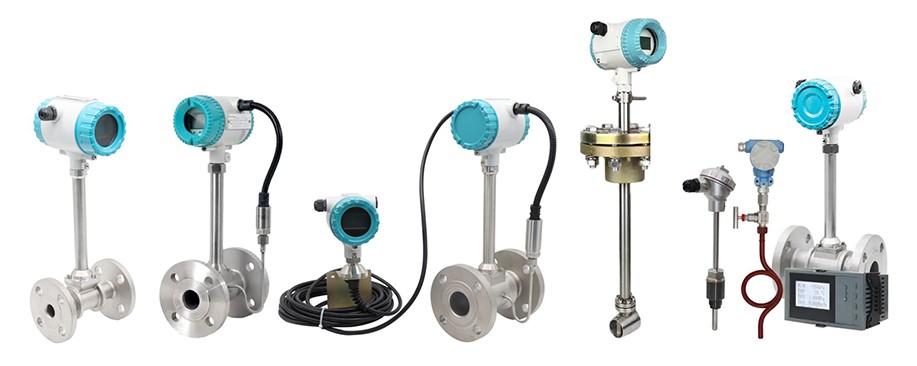
1. What Is a Steam Flow Meter?
A steam flow meter is used to measure the instantaneous and total mass flow of saturated steam and superheated steam. It is widely used in:
- Boiler steam headers
- Heat exchange stations
- Workshop steam branch lines
- District heating and steam distribution networks
- Energy consumption monitoring
- Steam cost allocation
- Internal metering
- Trade and commercial measurement
The volume of steam changes significantly with temperature and pressure. Therefore, simply measuring the volumetric flow rate under operating conditions is often not sufficient for steam metering. The flow rate generally needs to be converted into mass flow, such as kg/h or t/h.
For saturated steam, temperature and pressure have a defined relationship, so single-parameter compensation may be possible depending on the measurement method and application.
For superheated steam, both temperature and pressure compensation are normally required.
Wet steam contains both vapor and liquid phases. The presence of condensate can significantly increase measurement uncertainty and cause unstable readings.
When preparing a technical specification for purchasing a steam flow meter, clearly define:
- Steam type
- Operating pressure and temperature range
- Steam dryness fraction
- Required output unit, such as kg/h or t/h
- Compensation method and algorithm
- Calibration requirements
- Traceability requirements
- Applicable metering regulations for trade measurement applications
2. How to Choose a Steam Flow Meter? 10 Key Selection Factors
1. Define the Measurement Purpose
Different applications have different measurement requirements.
For example:
- Boiler header trade measurement
- Heat station energy accounting
- Workshop steam cost allocation
- Equipment steam consumption monitoring
- General process monitoring
Trade measurement places greater emphasis on calibration certificates, traceability, verification requirements, and measurement uncertainty.
Energy management applications usually focus more on stable totalized flow and reliable communication with the control system.
For general process monitoring, rangeability and resistance to site disturbances may be more important.
Therefore, the measurement purpose should be defined before selecting the flow meter.
2. Steam Type, Dryness, Condensate, and Water Hammer
First determine whether the application involves:
- Dry saturated steam
- Superheated steam
- Wet steam
Wet steam contains liquid condensate, which can cause several problems, including:
- Erosion of sensing components
- Unstable signals
- Increased measurement error
- Water hammer
- Mechanical stress on the pipeline and flow meter
The steam dryness fraction and condensate drainage arrangement should therefore be provided to the manufacturer during the selection process.
Where possible, the flow meter should be installed at an appropriate elevated position in the steam line and should not be installed at a low point where condensate can accumulate.
For wet steam applications, improving the steam drainage system is generally more effective than relying solely on software compensation.
3. Pipe Size, Actual Flow Rate, and Flow Velocity
Pipe diameter alone is not enough to select a steam flow meter.
The manufacturer should receive at least three flow conditions:
- Minimum flow
- Normal operating flow
- Maximum flow
Vortex flow meters are particularly sensitive to low flow velocity.
For many steam applications, a commonly used operating velocity range is approximately 5–35 m/s, but the actual recommended range should always be verified against the specific flow meter model, steam pressure, temperature, pipe size, and operating conditions.
If the flow velocity remains too low, reducing the meter size can sometimes increase the velocity through the measurement section and improve measurement performance.
Excessively high velocity, however, may increase erosion and mechanical stress on the sensing components.
4. Pressure and Temperature
Before purchasing a steam flow meter, confirm:
- Maximum operating pressure
- Normal operating pressure
- Steam temperature
- Ambient temperature
- Expected pressure and temperature fluctuations
Allow sufficient margin for actual operating fluctuations.
Also distinguish between gauge pressure and absolute pressure, because steam density calculations depend on absolute pressure.
For remote or split-type flow meters, do not evaluate temperature resistance based only on the temperature rating shown on the converter. The sensor, converter, seals, cables, and other components may have different temperature limits.
Always check the complete ordering specification.
5. Accuracy, Repeatability, and Error Definition
A specification such as ±1.0% or ±1.5% does not provide enough information by itself.
Buyers should determine whether the accuracy refers to:
- Reading error
- Full-scale error
- A specific flow range
- The complete measurement range
When requesting a quotation, ask the manufacturer for:
- Accuracy specification
- Calibration medium
- Calibration conditions
- Calibration points
- Repeatability
- Calibration uncertainty
- Traceability information
For steam applications, installation quality and condensate conditions can sometimes introduce more measurement error than the intrinsic accuracy of the flow meter itself.
6. Turndown Ratio and Low-Flow Performance
The advertised turndown ratio does not necessarily represent the usable turndown ratio under actual steam operating conditions.
At low flow velocity, the Reynolds number may be insufficient for stable vortex measurement, resulting in poor measurement performance or loss of measurement capability.
As a practical selection principle, the normal operating flow should ideally fall within a stable portion of the meter's measuring range rather than close to its minimum or maximum limit.
For important applications, the minimum acceptance flow rate should be explicitly included in the testing and acceptance plan.
7. Pressure Loss
Steam is an energy-intensive medium, so pressure loss across the flow meter should not be ignored.
Additional pressure loss may increase operating costs and affect the efficiency of the steam system.
Generally:
- Vortex flow meters have relatively low pressure loss.
- Standard orifice plates can produce significant permanent pressure loss.
- Averaging Pitot tube flow meters have very low pressure loss and can be attractive for large-diameter steam pipelines.
The pressure loss should therefore be calculated according to the actual flow velocity and operating conditions rather than comparing flow meters only by their purchase price.
8. Straight Pipe Length, Vibration, and Installation Location
Elbows, valves, tees, reducers, and other fittings can disturb the flow profile.
Steam pipelines may also experience significant mechanical vibration.
For a typical Aister ATLU vortex flow meter installation:
- Upstream straight pipe length: ≥10D
- Downstream straight pipe length: ≥5D
- If an upstream valve or elbow causes significant disturbance: the upstream straight pipe length may need to be increased to approximately 20D
- A flow conditioner may be considered when the available straight pipe length is insufficient
Here, D represents the internal diameter of the pipeline.
For severe vibration applications, a remote/split configuration may help reduce the effect of pipeline vibration on the converter. Differential pressure technology can also be evaluated when vibration is difficult to control.
The actual installation requirements should always follow the manufacturer's installation manual and project-specific technical specification.
9. Output Signals and System Integration
Common communication and output options include:
- 4–20 mA
- Pulse output
- RS485 / Modbus
- HART
Before ordering, confirm:
- Communication protocol and version
- Register map
- Electrical isolation
- Power supply
- Totalizer data retention during power failure
- PLC/DCS/SCADA compatibility
- Communication documentation
A flow meter with the required hardware interface but insufficient communication documentation can significantly increase commissioning and integration costs.
10. Calibration, Installation, and Final Acceptance
Before purchasing, verify the manufacturer's calibration capabilities, including:
- Calibration facility
- Calibration medium
- Calibration points
- Calibration certificate
- Traceability chain
- Recommended recalibration interval
For trade measurement applications, also verify the applicable local metrology and certification requirements.
During site acceptance, check:
- Actual pipe internal diameter
- Installation direction
- Straight pipe length
- Drainage and steam trap performance
- Grounding
- Vibration protection
- Power supply stability
- Electrical interference
- Communication stability
When a measurement problem occurs, distinguish between an installation/process problem and a flow meter performance problem before replacing the instrument.
3. How Do the Four Main Steam Flow Measurement Technologies Compare?
| Technology | Measurement Principle | Key Advantages | What to Verify | Typical Applications |
|---|---|---|---|---|
| Temperature & Pressure Compensated Vortex Flow Meter | Kármán vortex frequency corresponds to flow velocity; integrated temperature and pressure compensation calculates mass flow | No moving parts, relatively low pressure loss, integrated design, low maintenance, good cost-performance ratio | Minimum flow velocity, pipeline vibration, straight pipe length, wet steam and condensate erosion | DN25–DN300 dry saturated or superheated steam; heat stations, workshop branch lines, plant energy metering |
| Standard Orifice Differential Pressure Flow Meter | Restriction device generates differential pressure, combined with a DP transmitter and temperature/pressure compensation | Mature technology, strong temperature/pressure resistance, suitable for very large pipelines | High pressure loss, orifice wear, long straight pipe requirements, impulse line condensation | High-temperature/high-pressure main lines, large steam networks, stable-condition trade measurement |
| Averaging Pitot Tube Flow Meter | Multiple pressure measurement points obtain an average differential pressure | Very low pressure loss, economical for large pipes, relatively convenient installation | Moderate accuracy, probe fouling/blockage, straight pipe requirements | DN300+ large steam headers, process monitoring, applications where high-accuracy billing is not required |
| Elbow Flow Meter | Uses the centrifugal pressure difference generated by flow through an elbow | No additional throttling element, almost no additional pressure loss, resistant to erosion | Moderate accuracy, elbow manufacturing accuracy | Large-diameter contaminated steam pipelines, general process monitoring |
Important Note
Thermal mass flow meters should not be used for steam measurement. Steam may contain liquid condensate, and direct exposure of a thermal mass sensor to steam/condensate conditions can damage the thermal sensing element.
There is no universally superior measurement technology.
Vortex flow meters are widely used for small- and medium-diameter steam pipelines, but they are sensitive to severe vibration and excessive condensate.
Differential pressure technologies can tolerate demanding operating conditions, but they generally involve greater pressure loss and more maintenance.
For wet steam, the preferred approach is to improve the steam drainage and condensate management system rather than relying solely on instrument algorithms to compensate for two-phase flow.
4. Why Consider Aister Instrument as a Steam Flow Meter Supplier?
The Aister Instrument ATLU vortex flow meter is designed for saturated and superheated steam measurement. The product family includes inline, insertion, and split-type high-temperature configurations and can be equipped with integrated temperature and pressure compensation.
This provides options for applications ranging from small and medium steam pipelines to large-diameter retrofit projects.
For projects where the operating conditions are uncertain, the steam dryness fraction, pipeline vibration, and condensate drainage conditions can be evaluated before selecting the appropriate configuration.
Rather than forcing every application into a single measurement principle, buyers can compare different technologies according to the actual operating conditions.
A Key Point for Buyers
Being included on a shortlist does not mean that one flow meter is suitable for every application.
Whether Aister is appropriate for a specific project depends on:
- Selected model and specifications
- Operating pressure and temperature
- Flow range
- Calibration and certification
- Installation conditions
- Steam quality
- Pipeline vibration
- Condensate drainage
- Site testing results
- After-sales support
The specifications below are based on publicly available product information. Before signing a purchase contract, always confirm the latest datasheet and technical agreement with the manufacturer.
5. Aister ATLU Vortex Flow Meter for Steam Measurement
Product Positioning
The ATLU series uses the Kármán vortex principle and is designed for measuring saturated and superheated steam.
Available connection configurations include:
- Flanged
- Wafer
- Insertion
- Tri-clamp
An integrated temperature and pressure compensation module can be configured to calculate and directly output steam mass flow.
Key Specifications
| Parameter | ATLU Specification |
|---|---|
| Nominal Diameter | Inline type: DN25–DN300; insertion type can cover larger pipe sizes |
| Accuracy | Gas/steam: ±1.0–1.5% of reading; insertion type: ±2.5% |
| Working Pressure | 1.6, 2.5, 4.0, 6.4 MPa options |
| Medium Temperature | Standard: -40 to 150°C; medium temperature: -40 to 250°C; high-temperature split type: -40 to 350°C |
| Output | 4–20 mA, pulse, RS485/Modbus; explosion-proof options available |
| Installation | Typically ≥10D upstream and ≥5D downstream; ≥20D upstream may be required after upstream valves or elbows |
Core Advantages
No Moving Parts
The vortex flow meter has no mechanical moving parts in the flow measurement structure, reducing mechanical wear and routine maintenance requirements.
Integrated Temperature and Pressure Compensation
The integrated compensation function can calculate steam mass flow and provide output in units such as t/h, depending on the selected configuration.
Multiple Connection Options
Flanged, wafer, insertion, and other configurations allow the ATLU series to be used in different pipeline designs and retrofit projects.
Split Configuration for High-Temperature or Vibration Applications
The split-type configuration separates the sensor and converter, which can help reduce the influence of high temperature or pipeline vibration on the electronics when properly configured.
Suitable for New Installations and Retrofit Projects
The product range covers inline and insertion configurations, making it possible to evaluate solutions for both new steam systems and large-diameter pipeline retrofits.
Limitations and Potential Risks
The ATLU vortex flow meter still has a minimum flow velocity requirement. Measurement performance may deteriorate when the flow velocity is too low.
Strong pipeline vibration can interfere with the vortex signal.
Wet steam, excessive condensate, and water hammer may cause erosion or mechanical impact on the vortex shedding body and can significantly increase measurement uncertainty.
Therefore, the upstream drainage and condensate management system should be properly designed and maintained.
For high-temperature split-type models, the sensor and converter have different specifications and must not be mixed arbitrarily. The actual ordering specification should always be used as the final reference.
Recommended Applications
The ATLU series is suitable for applications involving:
- Dry saturated steam
- Superheated steam
- Boiler steam distribution systems
- Steam headers and branch lines
- Heat exchange stations
- Workshop steam pipelines
- Plant-level energy management
The flow velocity should remain within the recommended operating range, and pipeline vibration should be controllable.
6. Aister ATLU Vortex Flow Meter Solution Summary
| Brand / Series | Technology | Main Specifications | Key Advantages | Main Limitations | Recommended Applications |
|---|---|---|---|---|---|
| Aister ATLU | Kármán vortex + temperature & pressure compensation | Inline DN25–DN300; insertion type for larger pipes; up to 350°C with high-temperature split type; pressure up to 6.4 MPa; accuracy 1.0–2.5% depending on configuration | Integrated temperature/pressure compensation; multiple connection options; split configuration; designed for steam measurement | Limited by minimum flow velocity, vibration, and condensate erosion | Dry saturated and superheated steam; heat stations, workshop branch lines, large-diameter retrofit projects |
7. How to Determine Whether Aister ATLU Is Suitable for Your Project: 5-Step Verification Process
Do not place an order based solely on marketing materials or a general product brochure.
A complete technical verification process is recommended.
Step 1: Submit a Complete Operating Condition Sheet
Provide the manufacturer with:
- Steam type
- Steam dryness fraction
- Condensate and steam trap configuration
- Pipe internal diameter
- Minimum, normal, and maximum flow rates
- Operating pressure and temperature
- Flow velocity range
- Pipeline vibration level
- Upstream and downstream fittings
- Available straight pipe length
- Explosion-proof requirements
- Power supply
- Communication requirements
- Required output unit
The more complete the operating data, the lower the risk of incorrect instrument selection.
Step 2: Obtain a Written Selection Recommendation
Ask the manufacturer to provide written confirmation of:
- Complete model number
- Measuring range
- Accuracy definition
- Temperature and pressure compensation method
- Pressure loss
- Straight pipe requirements
- Wetted material
- Temperature and pressure ratings
- Explosion-proof certification
- Communication register map
- Installation drawing
- Applicable wet-steam operating limits
For wet-steam applications, the acceptable operating boundary should be clearly stated in writing.
Step 3: Verify Calibration Evidence
Check:
- Calibration medium
- Calibration flow points
- Calibration facility
- Reference standards
- Calibration certificate
- Traceability chain
- Recommended recalibration interval
For trade measurement applications, confirm that the certification and traceability meet the applicable local requirements.
Step 4: Conduct a Sample or Comparison Test
Where practical, install the sample flow meter in series with a suitable reference meter and compare the readings under:
- Minimum flow
- Normal flow
- Maximum flow
During testing, record:
- Steam pressure
- Steam temperature
- Flow rate
- Condensate drainage condition
- Flow meter output
- Reference meter output
This provides much stronger evidence than relying only on the nominal accuracy stated in a datasheet.
Step 5: Perform Site Acceptance Testing
A practical acceptance test can include continuous operation for approximately 7 days, with attention to:
- Zero stability
- Totalized flow
- Peak and low flow readings
- Communication stability
- Power-failure recovery
- Influence of condensate
- Pipeline vibration
- Steam drainage performance
The final acceptance criteria should be based on the agreed operating conditions and technical specifications.
Only after these conditions are verified should the flow meter be considered fully qualified for the application.
8. Frequently Asked Questions
Q1: Which Steam Flow Meter Brand Is the Best?
There is no brand that is universally suitable for every steam application.
The final decision should be based on:
- Actual operating conditions
- Measurement technology
- Applicable flow range
- Calibration and certification
- Sample testing results
- Installation conditions
- After-sales support
- Contractual acceptance requirements
A suitable steam flow meter is one that performs reliably under the actual operating conditions—not simply the one with the highest advertised accuracy.
Q2: How Well Does the Aister ATLU Perform for Steam Measurement?
The ATLU vortex flow meter supports integrated temperature and pressure compensation and can be configured for saturated and superheated steam measurement.
The series offers inline, insertion, and split-type configurations.
For a specific project, buyers should pay particular attention to:
- Minimum flow velocity
- Pipeline vibration
- Steam dryness
- Condensate drainage
- Straight pipe length
- Operating pressure and temperature
For wet-steam or two-phase flow applications, the manufacturer should provide written confirmation of the applicable operating limits, followed by appropriate site testing.
Q3: Does a Steam Flow Meter Always Need Temperature and Pressure Compensation?
In most steam mass-flow applications, compensation is important.
For saturated steam, temperature or pressure compensation may be used depending on the measurement configuration and steam condition.
For superheated steam, both temperature and pressure are normally required for accurate density calculation.
Without appropriate compensation, density calculations can become inaccurate, resulting in significant errors in calculated mass flow.
Q4: Can a Vortex Flow Meter Measure Wet Steam?
A vortex flow meter may be capable of operating under certain wet-steam conditions, but its performance depends strongly on the amount of liquid condensate and the specific meter design.
It should not be assumed that a vortex flow meter can reliably handle large amounts of condensate or severe water hammer.
For wet-steam applications:
- Improve the steam drainage system first.
- Provide the manufacturer with the steam dryness information.
- Obtain written confirmation of the applicable wet-steam operating limits.
- Conduct site verification where measurement accuracy is critical.
Software compensation cannot completely eliminate the uncertainty associated with severe two-phase flow.
Q5: How Should I Choose Between an Inline and an Insertion Vortex Flow Meter?
An inline vortex flow meter provides a controlled measurement cross-section and generally offers more predictable measurement performance.
It is commonly considered for new installations and smaller or medium-sized pipelines, such as applications up to approximately DN300 depending on the specific product range.
An insertion vortex flow meter can reduce installation and equipment costs for large-diameter pipelines and is particularly useful for retrofit applications.
However, insertion meters are more sensitive to:
- Actual pipe internal diameter
- Flow profile
- Installation depth
- Installation position
- Straight pipe conditions
For large-diameter steam headers, the insertion configuration should therefore be evaluated carefully according to the actual pipeline conditions.
Q6: Why Do Two Steam Flow Meters Show Different Mass Flow Readings?
Different readings do not necessarily mean that one of the flow meters is defective.
Common causes include:
- Different compensation algorithms
- Incorrect temperature or pressure measurement locations
- Poor condensate drainage
- Insufficient straight pipe length
- Distorted flow profile
- Flow velocity below the meter's minimum operating range
- Pipeline vibration
- Different calibration conditions
- Different density calculation methods
Before comparing two meters, make sure that the compensation logic and measurement conditions are consistent.
The steam drainage system should also be checked.
Q7: What Information Should I Provide to the Manufacturer for Steam Flow Meter Selection?
At minimum, provide:
- Steam type
- Steam dryness fraction
- Condensate and steam trap configuration
- Pipe internal diameter
- Minimum, normal, and maximum flow rates
- Operating pressure
- Operating temperature
- Flow velocity range
- Pipeline vibration
- Upstream and downstream fittings
- Straight pipe length
- Connection type
- Temperature and pressure requirements
- Explosion-proof requirements
- Power supply
- Communication protocol
- Output unit
- Whether the application involves trade measurement
Complete operating data significantly reduces the risk of selecting an unsuitable flow meter.
9. Conclusion
Steam flow meter selection should never be based on brand reputation alone.
The main risks come from the nature of the steam itself: high temperature, high pressure, condensate and two-phase flow, water hammer, and pipeline vibration.
Before selecting the instrument, first confirm the steam dryness and condensate drainage conditions. Then evaluate the appropriate measurement technology based on:
- Pipe diameter
- Minimum, normal, and maximum flow
- Flow velocity
- Pressure and temperature
- Pipeline vibration
- Pressure loss
- Measurement accuracy
- Communication requirements
- Calibration and certification requirements
The Aister ATLU integrated temperature and pressure compensated vortex flow meter provides a range of configurations for saturated and superheated steam applications and can be considered as a Chinese-made steam flow meter option for projects requiring different installation configurations and technical support.
However, being on the supplier shortlist is only the beginning.
For final procurement, buyers should use the latest datasheet, valid certificates, sample testing results, written technical specifications, and agreed acceptance criteria as the basis for the final decision.
For applications involving severe wet steam, frequent water hammer, strong pipeline vibration, or insufficient straight pipe length, improving the piping and condensate management system should come first. Where necessary, conduct a dedicated application test before placing a large-volume order.
Send us your pipe diameter, medium, flow range, pipe material, and installation requirements. Our technical team can help you select a suitable flow meter configuration for your project.
Share To:
Next Post:
News
- Why is the thermal gas mass flowmeter not affected by pressure strength and temperature?
- What to do when a thermal gas mass flow meter fails?
- How are thermal gas mass flow meters used? What are the applications?
- Under what circumstances is the gas measurement need to be regulated compensated vortex flowmeter
- Why Is The Aister Thermal Gas Mass Flowmeter So Popular ?
- Gas turbine flowmeter manufacturers explain their main advantages in measurement
- Gas turbine flowmeter manufacturer Aister instrument field experience summary
- Aister Instrument Empowerment Conference