

Wastewater Flow Meter Selection Guide: How to Choose the Right Solution for Your Project
2026-10-10
Wastewater measurement presents a wide range of challenges, from municipal sewage and industrial acid or alkaline wastewater to sludge-laden fluids, wastewater containing sand or fibers, and open-channel drainage. These applications often involve corrosive media, abrasive particles, suspended solids, and entrained air, making reliable flow measurement more demanding than in clean-water applications.
There is no universal wastewater flow meter that works perfectly under every operating condition. The right selection process starts with understanding the actual site conditions, matching the measurement principle to the application, selecting suitable materials and configurations, and evaluating the manufacturer's product quality and after-sales support.
This guide covers five key aspects of wastewater flow meter selection: operating conditions, flow meter comparisons, material and configuration choices, brand selection, and application-specific solutions. Follow these steps to identify a wastewater flow measurement solution that fits your project, delivers stable long-term performance, and offers the right balance between reliability and cost.
1. Before You Buy: Six Essential Operating Conditions to Confirm
Many wastewater flow measurement problems, including inaccurate readings, frequent equipment failures, and shortened service life, can be traced to incomplete information during the initial selection process. Before choosing a meter, confirm the following six factors.
1.1 Pipe and Channel Configuration
First, determine whether the wastewater flows through a closed, full-pipe pressurized pipeline or an open channel or partially filled pipe. This distinction directly determines which type of flow meter is suitable.
-
Small- and medium-diameter full pipes: Conventional inline flow meters are generally suitable.
-
Large-diameter pipelines: Insertion-type solutions may help reduce installation and equipment costs, depending on the application.
-
Open drainage channels and discharge outlets: A dedicated open-channel flow measurement system is required.
1.2 Wastewater Characteristics
Wastewater composition is one of the most important factors in flow meter selection. Identify the concentration of suspended solids, the presence of sand and fibers, oil contamination, entrained air, pH level, and the degree of chemical corrosiveness.
Different combinations of suspended particles, abrasive materials, and corrosive chemicals place very different demands on a flow meter's resistance to clogging, wear, and chemical attack. Choosing the wrong wetted materials or measurement principle can lead to unstable readings and premature equipment failure.
1.3 Actual Flow Rate Range
Determine the minimum, normal, and maximum flow rates expected during operation.
For many applications, selecting a meter so that normal operating flow falls within approximately 30%–80% of its configured measuring range can provide a useful starting point. However, the appropriate range depends on the meter's specified accuracy, turndown ratio, and the project's minimum-flow requirements.
A properly selected range helps avoid poor low-flow performance and over-range conditions during peak discharge.
1.4 Installation Conditions
Check whether the pipeline can be cut for installation, whether an existing system must be upgraded without shutting down operations, and whether sufficient upstream and downstream straight pipe lengths are available.
Also assess environmental conditions, including high humidity, standing water, electromagnetic interference, and severe mechanical vibration. These factors may influence the choice between an integral and remote transmitter, the required enclosure protection, and the installation method.
1.5 Application and Compliance Requirements
Clarify the purpose of the measurement before selecting a model. Common applications include internal process monitoring, water consumption accounting, environmental compliance monitoring, and commercial or custody-transfer measurement.
For projects in China that require environmental monitoring approval, verify whether the applicable CPA metrology certification and CCEP environmental protection product certification are required for the specific application and instrument model. For overseas projects, confirm the local regulatory requirements and any applicable measurement or environmental certifications.
For routine internal monitoring, measurement performance, durability, maintenance requirements, and total ownership cost may be more important than certifications that are not required by the project.
1.6 Power Supply and Communication Interfaces
Determine the available power supply and the communication functions required by the control system.
Common options include 4–20 mA analog output, RS485 with Modbus RTU, and wireless data transmission through technologies such as 4G or NB-IoT, where supported.
Confirm compatibility with the site's PLC, DCS, energy management system, or environmental monitoring platform before placing an order. This helps avoid additional integration costs and communication problems during commissioning.
2. Comparing the Main Types of Wastewater Flow Meters
Three main categories are commonly used for wastewater measurement: electromagnetic flow meters, ultrasonic flow meters, and open-channel flow measurement systems.
Other instruments, such as vortex and rotameter flow meters, have more limited applications and are generally unsuitable for typical wastewater pipelines containing significant amounts of solids or debris.
2.1 Electromagnetic Flow Meter: A Leading Choice for Full-Pipe Wastewater Measurement
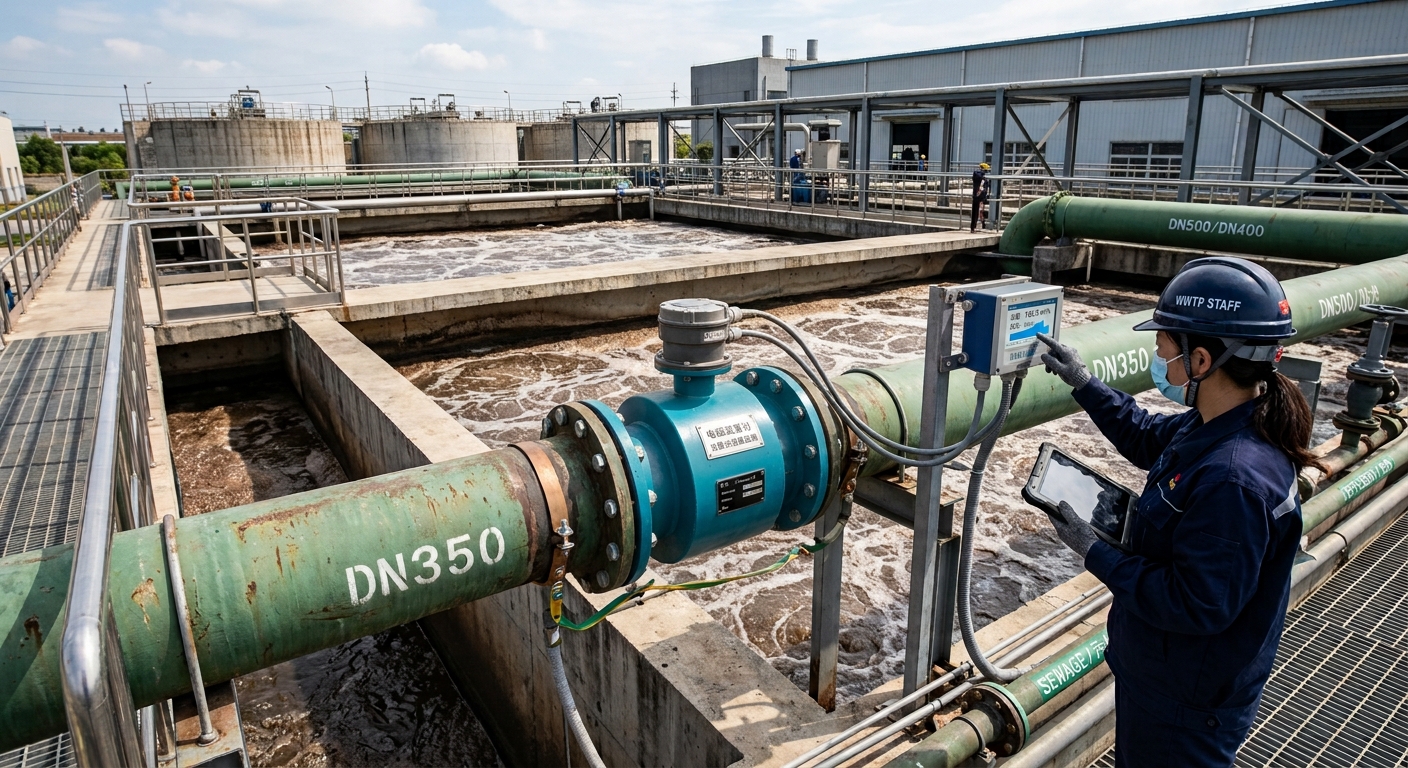
Electromagnetic flow meters operate according to Faraday's law of electromagnetic induction. They are widely used in municipal sewage systems and industrial wastewater treatment because they have no moving mechanical parts and are generally resistant to clogging caused by suspended solids and fibers.
Their main advantages include:
-
Low maintenance requirements: The absence of moving parts reduces mechanical wear and routine maintenance.
-
Stable measurement: Readings are largely independent of fluid viscosity and are not directly affected by changes in temperature and pressure under normal operating conditions.
-
No additional pressure loss from internal obstructions: The unobstructed measuring tube helps minimize energy losses.
-
High measurement accuracy: Certain models can achieve accuracy of ±0.5%, depending on the model and operating conditions.
-
Wide nominal diameter coverage: Available configurations can cover approximately DN15 to DN2000, depending on the manufacturer and model.
Suitable applications:
-
Municipal sewage and domestic wastewater
-
Chemical wastewater containing acids or alkalis
-
Dyeing, printing, electroplating, and other industrial wastewater
-
Conductive wastewater containing suspended solids or fibers
Limitations to consider:
Electromagnetic flow meters require an electrically conductive liquid. A minimum conductivity of approximately 5 μS/cm is common for some models, but the actual requirement must be checked against the manufacturer's specifications. They are not suitable for pure water with insufficient conductivity or for nonconductive oil-based fluids.
The measuring pipe must remain completely full for reliable readings. Partially filled pipes can produce significant measurement errors. Proper grounding and electrical installation are also essential to minimize interference and signal instability.
2.2 Ultrasonic Flow Meter: A Practical Option for Existing Pipelines and Large Diameters
Ultrasonic flow meters measure flow using sound waves. Depending on the technology and installation method, they can be useful for existing pipelines, temporary monitoring, and large-diameter wastewater systems.
Two common measurement principles are transit-time and Doppler.
-
Transit-time ultrasonic flow meters: Generally better suited to relatively clean liquids with limited suspended solids and entrained air.
-
Doppler ultrasonic flow meters: Designed for liquids containing sufficient suspended particles or gas bubbles to reflect ultrasonic signals.
For wastewater applications, the measurement principle must be matched to the actual fluid. Neither technology is universally suitable for every wastewater composition.
Ultrasonic flow meters are also available in different installation configurations.
-
Clamp-on ultrasonic flow meters: Installed externally without cutting the pipe or directly contacting the wastewater. They are particularly useful for retrofit projects and temporary measurements.
-
Insertion-type ultrasonic flow meters: Installed through an opening in the pipe. Depending on the design and installation conditions, they may provide a stronger signal or more suitable long-term performance than clamp-on units.
Suitable applications:
-
Existing pipelines where cutting the pipe is difficult or shutdowns are undesirable
-
Large-diameter wastewater pipelines, particularly DN300 and above
-
Temporary flow monitoring and troubleshooting
Limitations to consider:
High concentrations of suspended solids, excessive air bubbles, and heavy deposits on the pipe wall can interfere with ultrasonic signals and reduce measurement accuracy. Clamp-on performance also depends on pipe material, wall thickness, lining, and surface condition.
For difficult wastewater containing substantial sludge or abrasive solids, the suitability of the selected ultrasonic technology should be verified before purchase. Typical stated accuracy for some ultrasonic flow meter models is around ±1%–2%, but actual performance varies by design and installation conditions.
2.3 Parshall Flume Flow Measurement System: A Standard Option for Open-Channel Discharge
A Parshall flume flow measurement system typically consists of a Parshall flume, an ultrasonic level sensor, and a flow totalizer or flow computer.
It determines flow rate from the measured liquid level and the calibrated relationship between level and discharge. The system has a relatively simple structure, offers good resistance to clogging when properly selected, and is often more economical than installing a conventional full-pipe flow meter in an open channel.
With the appropriate instrumentation and configuration, it can also support data transmission to environmental monitoring platforms.
Suitable applications:
-
Wastewater treatment plant outlet channels
-
Municipal drainage channels
-
Open industrial wastewater discharge outlets
-
Combined stormwater and wastewater discharge channels
Limitations to consider:
A Parshall flume system is intended for suitable open-channel flow conditions. It is not a direct replacement for an inline flow meter in a closed, pressurized pipeline.
Installation geometry, upstream flow conditions, downstream submergence, channel dimensions, and level sensor positioning must be considered to obtain reliable results. Regulatory certification and reporting requirements should also be verified for the project location.
2.4 Less Common Options: Generally Unsuitable for Typical Wastewater Pipelines
Vortex flow meters are generally more appropriate for suitable clean or relatively clean liquids, gases, and steam. Abrasive particles can damage the bluff body or sensor, while fibers and deposits may interfere with measurement. They are therefore not a preferred choice for wastewater containing substantial suspended solids unless the specific application has been carefully evaluated.
Rotameters, also known as variable-area flow meters, are mainly used for small-flow applications such as sampling lines and chemical dosing pipelines. Some small-bore models are suitable for selected auxiliary applications, but rotameters are generally not appropriate for measuring the main flow in large wastewater pipelines.
3. Key Configuration Choices: Materials Directly Affect Service Life
Selecting the correct measurement principle is only the first step. For electromagnetic flow meters, the compatibility of the liner and electrode materials with the wastewater can directly affect corrosion resistance, abrasion resistance, measurement reliability, and equipment service life.
3.1 Selecting the Right Liner Material
Rubber liner — General municipal wastewater
Rubber liners are commonly used for municipal sewage and ordinary wastewater applications. They offer a practical balance between cost, flexibility, and durability under suitable operating conditions.
Polyurethane liner — Abrasive wastewater
For wastewater containing sand, sludge, and other abrasive particles, polyurethane may provide improved abrasion resistance and impact resistance. It is worth considering when mechanical wear is a major concern, subject to the chemical compatibility and temperature limits of the selected material.
PTFE liner — Chemically aggressive wastewater
Polytetrafluoroethylene (PTFE) offers broad chemical resistance and is often used for acidic, alkaline, and other corrosive industrial wastewater applications. However, compatibility must be verified against the actual chemicals, concentrations, and operating temperatures.
3.2 Selecting the Right Electrode Material
316L stainless steel electrodes — General wastewater
316L stainless steel is a common and economical choice for conventional wastewater applications where the chemical composition and chloride concentration are within acceptable limits.
Hastelloy electrodes — Complex industrial wastewater
Hastelloy alloys may be suitable for industrial wastewater from electroplating, papermaking, pharmaceutical production, and chemical processing. The appropriate alloy depends on the specific combination of acids, alkalis, salts, and other contaminants.
Titanium electrodes — Selected saline and chloride-containing wastewater
Titanium can offer good resistance to certain chloride-containing environments and seawater-related applications. Its suitability depends on the chloride concentration, pH, temperature, and other chemical conditions.
Tantalum electrodes — Highly corrosive media
Tantalum offers excellent resistance to many strongly corrosive chemicals and may be appropriate for demanding acid applications. Because of its high material cost, it is generally reserved for applications where the required corrosion resistance justifies the expense.
Important: No single electrode or liner material is suitable for every corrosive wastewater application. Always confirm chemical compatibility with the manufacturer before finalizing the configuration.
3.3 Installation-Specific Configurations
Underground manholes and humid environments
For installations in underground manholes or locations subject to standing water, a remote-transmitter configuration may be preferable. Select a sensor with an appropriate ingress protection rating, such as IP68, if continuous immersion is expected and explicitly supported by the manufacturer. Install the transmitter in a dry, accessible location whenever possible.
PVC and PE nonmetallic pipelines
Nonconductive pipes may require dedicated grounding rings or other manufacturer-approved grounding arrangements to establish a stable electrical reference. Confirm the correct configuration for the specific pipe material and installation.
Environmental compliance projects
For projects in China that require environmental monitoring certification, prioritize models with the applicable CPA and CCEP certifications. For international projects, verify the local approval requirements rather than assuming that Chinese certifications automatically satisfy them.
4. Flow Meter Brands and Cost Considerations
The Chinese wastewater flow meter market offers a wide range of domestic alternatives to imported equipment. For many standard municipal and industrial projects, domestic manufacturers can provide competitive pricing, practical product configurations, and responsive local technical support.
Imported brands may still be appropriate for specialized applications with demanding performance requirements. The final choice should depend on the operating conditions, project specifications, budget, and service requirements.
4.1 Premium International Brands: For Demanding Applications
Endress+Hauser (E+H) is an established international instrumentation brand. Its electromagnetic flow measurement products offer mature measurement technology, diagnostic functions, and configurations for a wide range of industrial applications.
Such equipment may be worth considering for demanding chemical processing, pharmaceutical production, and applications requiring tightly controlled measurement performance or specialized integration.
However, imported instruments can involve higher purchase prices, longer delivery times, and more complicated service arrangements in some markets. For routine wastewater engineering projects, the additional cost should be evaluated against the actual technical requirements and lifecycle benefits.
4.2 Leading Chinese Brands: Practical Options for Engineering Projects
Chongqing Chuanyi
Chongqing Chuanyi is an established Chinese industrial instrumentation manufacturer. Its product portfolio and industrial project experience make it a candidate for large municipal infrastructure, power generation, and petrochemical procurement projects. Buyers should verify the specific model's certifications, technical specifications, and project suitability.
Aister Instrument
Aister Instrument offers a range of industrial flow measurement products, including electromagnetic flow meters, open-channel flow measurement systems, and radar-based flow measurement solutions. Depending on the selected model, communication options can support integration with PLCs, DCS systems, and environmental monitoring platforms.
For overseas buyers, the key evaluation points include product specifications, available communication protocols, customization options, documentation, and after-sales support for the destination market.
SHANGHAI KENT
SHANGHAI KENT is another Chinese instrumentation brand that buyers may consider for municipal and industrial wastewater applications. When comparing suppliers, review the relevant product models, application references, measurement specifications, and long-term service capabilities.
Procurement tip: A manufacturer's reputation alone does not guarantee that a particular model is suitable for your wastewater conditions. Compare the actual specifications, wetted materials, certifications, installation requirements, warranty terms, and technical support available for your project.
4.3 Cost Comparison: Domestic vs. Imported Flow Meters
Chinese flow meter manufacturers often offer a cost advantage over international brands, particularly for standard engineering applications.
As a preliminary market reference, some buyers may find that:
-
Ultrasonic flow meters from Chinese suppliers cost approximately one-third to one-half as much as comparable imported models.
-
Electromagnetic flow meters from Chinese suppliers may cost approximately 50%–70% of the price of comparable imported models.
These are indicative comparisons rather than fixed market prices. Actual costs depend on nominal diameter, pressure rating, liner and electrode materials, accuracy requirements, communication functions, certifications, and order quantity.
When comparing quotations, consider the total cost of ownership, including installation, commissioning, maintenance, spare parts, and after-sales service, rather than focusing only on the initial purchase price.
5. Quick Wastewater Flow Meter Selection by Application
Use the following recommendations as a starting point for selecting a solution based on common site conditions.
Scenario 1: Closed, full-pipe wastewater pipelines, routine discharge, or environmental monitoring
Recommended solution: An integral or remote electromagnetic flow meter, with liner and electrode materials selected according to the wastewater composition. Confirm the required accuracy and regulatory certifications.
Scenario 2: Existing pipelines where water supply or production cannot be interrupted
Recommended solution: A clamp-on ultrasonic flow meter for non-invasive installation. If the application requires improved long-term measurement performance and the pipeline can accommodate an insertion installation, evaluate an insertion-type alternative.
Scenario 3: Open drainage channels, plant discharge outlets, and environmental monitoring
Recommended solution: A Parshall flume flow measurement system equipped with a suitable level sensor and flow totalizer. Confirm the channel geometry and applicable environmental reporting requirements.
Scenario 4: Underground manholes and wet installation environments
Recommended solution: A remote electromagnetic flow meter with a sensor rated for the actual immersion conditions, such as a suitable IP68 model, together with the appropriate grounding arrangement.
Scenario 5: Large-diameter wastewater pipelines, DN300 and above
Recommended solution: Evaluate insertion-type electromagnetic or ultrasonic flow meters when reducing installation costs is a priority. For insertion electromagnetic meters, verify the suitability of the design, grounding, flow profile, and required accuracy. Compare these options with conventional full-bore meters before making a final decision.
6. Final Principles for Choosing a Wastewater Flow Meter
The most reliable wastewater flow meter selection process follows three principles: operating conditions come before brand preference, material compatibility matters as much as measurement specifications, and installation quality determines long-term stability.
There is no need to choose an expensive imported instrument or pursue the highest advertised accuracy without considering the actual application. A suitable solution is one that matches the wastewater's conductivity, chemical composition, suspended solids, abrasion level, pipeline configuration, and installation environment.
For routine municipal and industrial wastewater projects, leading Chinese manufacturers can offer practical alternatives to imported equipment, often combining competitive pricing with suitable measurement performance and accessible technical support. For highly demanding measurement, commercial settlement, or extreme corrosion conditions, specialized international instruments may be worth considering.
Before placing an order, confirm the required flow range, pipe diameter, liner and electrode materials, installation conditions, communication interfaces, and applicable certifications. Proper grounding, suitable straight pipe lengths, full-pipe operation where required, and correct installation are equally important.
By matching the flow meter to the actual operating conditions and verifying the complete configuration before purchase, you can improve measurement reliability, reduce maintenance risks, and achieve better long-term value for your wastewater treatment or industrial process project.
Need help selecting a wastewater flow meter for your application? Contact Aister Instrument with your pipe diameter, minimum and maximum flow rates, wastewater composition, operating temperature, installation conditions, and required output signals. Our team can help you evaluate a suitable measurement principle and configuration for your project.
Contact our team for an expert consultation. Let us help you select the most efficient and cost-effective flow meter for your needs.
Share To:
Next Post:
News
- Why is the thermal gas mass flowmeter not affected by pressure strength and temperature?
- What to do when a thermal gas mass flow meter fails?
- How are thermal gas mass flow meters used? What are the applications?
- Under what circumstances is the gas measurement need to be regulated compensated vortex flowmeter
- Why Is The Aister Thermal Gas Mass Flowmeter So Popular ?
- Gas turbine flowmeter manufacturers explain their main advantages in measurement
- Gas turbine flowmeter manufacturer Aister instrument field experience summary
- Aister Instrument Empowerment Conference